Tuesday, 22 September 2015

Do human beings matter?

The sad situation, or not so sad and deserving according to many, of refugees from Syria and other nations that desperately want to find a new home in Europe and other Western nations has been in the news a lot lately. Some of the stories, and some comments from friends and family on Facebook, sadden and anger me, but there was an encouraging one in the BBC News yesterday.

In "How Sweden tries to assimilate its influx of refugees," Edwin Lane writes that the Swedish government, motivated by a desire to do what is morally right. even at considerable financial cost, welcomes many refugees every year, treating them with respect because they are human beings (2015). This includes helping them learn Swedish and other skills to fit into life and to find jobs that make the best use of their skills, which are often considerable.

Obviously, I think that other nations, every other nation, has an obligation to help the less fortunate, and that includes accepting them as refugees. Unfortunately, my mother is one of the Australians who think we should not offer such help to those desperately in need of it. This sometimes leads to uncomfortable moments at the dinner table on my visits home. I usually try not to comment when my mother is saying things with which I strongly disagree and find offensive, but every now and then, she says something so awful that I think she should be corrected, so I do. It does  not make her happy, but I suspect she calls refugees and immigrants lazy people who take the jobs of real Australians, and much worse, much less when I'm there because she knows I won't just let it all politely pass. Politeness is important, but you can be polite while honestly speaking unwelcome truths.  My mother is totally wrong factually as well as morally: nations that accept refugees tend to do better economically for the very good reason that such people are willing to work very hard to make a better life for themselves and their families. The Australiane xperience , also the experience of the US and many others, is strong evidence for this. Almost everyone in Australia, except the Aboriginal people who were there 40,000 years before we invaded, are at most second or third generation: my own Italian ancestors only sought a better life in Australia in the 1880s, and when they arrived, they worked very hard, contributing greatly to the economic and social health of Australia. That my own mother, whose own parents were immigrants, is so anti-immigrant seems a bit weird to me.

80,000 refugees a year, in
a county of less then 10 million.
But even for nations not founded on recent immigrants, it does seem to me the right thing to welcome in new citizens. Certainly, there are difficulties, but I think that people who are willing to make such a radical move are very likely to be both willing and able to succeed in their new home: the Chinese who settled in Thailand after the communist take over of China and earlier to escape the turmoil and poverty in their homeland seem to me to have contributed  a lot to Thailand. How many immigrants does Thailand settle permanently, granting them Thai citizenship each year? Tiny Sweden with with a population of only 10 million, takes in 80,000 new people who will become Swedish citizens every year. This puts my country to shame, although in the past, we have done much better. Perhaps it's economic fear that now drives Australia to be less generous, to be less willing to do the right thing morally. But I'm sure that that thinking is wrong. My Italian immigrant ancestors made Australia a better country, as did the Greeks, the Vietnamese, the Cambodians, and even the English who first invaded my country, turning the native residents they did not kill off into socially damaged outcasts living miserable lives.
__________
Reference
Lane, E. (2015, September 21). How Sweden tries to assimilate its influx of refugees. BBC News. Retrieved from http://www.bbc.com/news/business-34261065

Monday, 21 September 2015

Video games: good or bad for kids (and adults)?

When I was in primary school, TV was a relatively new technology: it was all black and white, and we were lucky to have two channels to choose from. My brothers and sisters and I rushed home from school to tune in for our daily dose of cartoons and kids shows, but many parents and others worried that it would damage our eyes and lead to moral decline in society.

In "Horizon: How video games can change your brain," the BBC says that contrary to the fears of some that video games can cause violent behaviour, there is mounting evidence that playing video games can be beneficial, developing motor and visual skills useful in such fields as surgery, as well as encouraging brain growth in the elderly and enhancing their mental sharpness (2015).

Sonic the Hedgehog appears to
have benefited pensioners.
One thing that distinguishes academic work from other pursuits is that whilst you are free to hold any opinion you want, in an academic environment, you are expected to be able to give solid support for your opinions, and to ditch them if they are proved wrong. I think I've been hearing for years people, usually older and with little hands on experience, warning of the dangers of video games, especially of violent, sex filled video games. In particular, that letting kids play them will cause an increase in violence in society. Like many opinions people have, this does sound plausible: surely, the things we look at and hear have an effect on us, and in the case of watching ultra-violent movies or playing video games full of murder, rape, war and other horrors, mustn't that effect be to make the watchers or players more likely to commit such acts themselves? But being plausible does not make an opinion true, and the evidence seems clear that watching films or playing games that include extreme sex and violence does not cause a personality shift towards greater violence, although there does seem to be some correlation between playing violent games and being violent. This surprised me a bit at first, but then other evidence more commonly available also supports that there is no causal link: Japan has very high rates of very violent, sex filled media, and is a remarkably non-violent society; similarly, as the amount of time teenagers and others have spent pursuing violent fantasies has increased, crime rates have dropped. Thailand's murder rate, for example, reduced from 8.1 / 100,000 in 2000 to 5.4 in 2009 (there was a sharp rise in 2003, but that was due to the Thai government's massively popular and morally wrong War on Drugs). If violence in society is actually decreasing, it seems unlikely that more time spent playing violent games causes violent behaviour.

Of course, there might be other reasons to not want children to play such games, but that they cause violence cannot one of those reasons. And in fact, I'm not sure that there is any very solidly supported reason - my rather indulgent mother let me watch late night adult films, and I don't think they warped my moral sensibilities. They were, rather, more material to think about and use to form a balanced view of the world. The BBC News article also uses the word theory, which has at least two very different meanings in science. My theory is that as well as the neurological and skill enhancing benefits of violent games, they also help kids to get a realistic breadth of understanding as to what human behaviour encompasses, and to develop their own, usually healthy, sense of what is morally OK and not OK by giving them more examples of situations to think about.

That said, I find both TV and video games very boring, or at least not worth my time. I haven't watched TV for about 35 years, and I try games every now and then, but they just don't excite me. This is a great disappointment to my friend Yo's son Ea - none of my devices have any games on them except the very small and unexciting set that come preloaded. A worrying thought: Did watching adult TV in my youth turn me into a boring adult? Is that why most societies today are less violent than when I was a child addictively watching TV?

__________
Reference
Horizon: How video games can change your brain. (2015, September 16). BBC News. Retrieved from http://www.bbc.com/news/technology-34255492

Sunday, 20 September 2015

Recording the path to now

When I was very young, primary school young, I used to hear an old cousin ranting on about the Beatles. She even had a glossy, green beetle medallion  that I remember clearly on a chain around neck, but the Beatles were all a vague mystery to me until many years later.

The BBC News story "The Beatles' first record contract sells for $75,000" tells how the Beatles first ever recording contract was for the song that got the interest of Brian Epstein, who quickly became their manager and led the English group to success (2015). According to the story, the group were working in nightclubs in Germany at the time, the early 1960s, and that first contract has just sold for $75,000 in New York.

Although I studied the flute for a while, music has never really been one of my passions, and as primary and high school student, I was much more interested in science, mathematics, and literature: I just didn't have time for music, and almost never listened to it. I guess it made me seem a bit odd at school, especially in high school, when everyone around me would talk about their musical favourites, and it seemed especially cool to love the Beatles, also Bob Dylan and other now ancient greats like Cat Stevens. This was before the time of Micheal Jackson, Madonna, and all that modern stuff, and way before the rise of Lady Gaga, who is the last famous one whose name comes to mind. One of my oldest friends in Bangkok, who I got to know well years earlier in Sydney, is now the manager who brings mega-stars to perform in Bangkok - I notice on his Facebook postings that recent splashes have included Bon Jovi (I've heard the name) and some new group (?) called Stamp. At least I'm familiar with Madonna, whom he's bringing out next year. But I'll skip her concerts, too.

I guess towards the end of high school I started to become interested in music. Actually, that's not an accurate memory, because I when I was in primary school, I did love singing old Australian folk songs, and I remember being fascinated listening to The Seekers, a great Australian group, performing live on TV - and that must have been when I was still in primary school. In fact, when I just checked on YouTube, The Seeker's farewell concert, which is the YouTube clip I've added above, was in 1968 - so I must have been hearing and loving them before that. So, now you know what my earliest passion in popular music was, and The Seekers truly were popular: despite the break up in 1968, they reformed and went on to record a lot more. For comparison, here's another YouTube offering, this one almost 50 years (that's right, half a century) after the one above.


And as I wrote about it, I was also having series doubt about my memories of my trendy cousin's beetle Beatles medallion - maybe I've conflated that memory with my memories of the glossy winged beetles that flew around my parents' property at dusk when I was at collecting lots of memories decades ago. But YouTube is a very reliable way to bring back memories.
__________
Reference
The Beatles' first record contract sells for $75,000. (2015, September 20). BBC News. Retrieved from http://www.bbc.com/news/world-us-canada-34306291

Welcome to AEP Reading and Writing 2, term 6, 2015

Welcome to our Reading and Writing level 2 (AB) class for the term.

Over the next six weeks, we will be working through a few chapters in Quest, which involve reading and writing several different kinds of texts. We will also add some extra reading and writing to keep things interesting every day; we will, for example, be reading a short novel and regularly writing on this class blog.

I hope you find the class useful and also enjoyable.

In the meantime, you might like to have a look at the blog posts below that students in level 2 (CD) wrote last term, and the new ones that I write over the coming days in response to recent articles published in the BBC News.

 Peter.

Monday, 7 September 2015

The Story of Time

During childhood, I liked to watch cartoon Doraemon—popular Japanese cartoon about cat robot travelling from the future world in 22nd century and having amazing magic stuff that are so advanced—because it is funny and full with a lot of creative imagination of the cartoon writer, and time machine for time travelling is one of the Doraemon’s magic stuff which frequently appears in several episode. At that time, Doraemon’s time machine is so fantastic that I didn’t realize that if it existed, would the chaos of changes in any actions or situations affecting to the world happen?
  
According to “Could time travel really take place?” (Coughlan, 2015), University of Birmingham is studying the feasibility of time travel, and will have to tackle some classic arguments against time travel like grandfather paradox—the paradox that it is impossible for someone could go back in time and then kill their grandparents who are their ancestors since they would have been never born. However, Dr. Wilson, specialist in the philosophy of physics, says that “examining time travel is a way of addressing questions about fundamental physics. It means thinking about time not as a way of measuring the passing of hours and days, but as a dimension more like space.”

In the aspect of science, as the grandfather paradox is, if we were able to travel back in time, all things would seem contrast and impossible. Nevertheless, the theory about parallel dimensions may be possible for time travelling since the consequence of changes in the past or the future will happen in other dimensions. To put it another way, only the parallel world in another dimension will be affected. Yet, there is no proof for this theory, just as the possible idea of some scientists to explain that paradox. Besides, one interesting question about the feasibility of time travelling is that if this is available, why can’t we see or meet ourselves coming from the future world?

In the view of spending time in one’s life, everybody has equal time (24 hours) in a day but spend it differently. Some can do and achieve many things in one day without any procrastination, whilst others cannot and spend their time in a useless manner regardless of the values of time. Thus, the latter seems to have a less tendency to be successful in their life. What is the difference? The answer is how well they manage limited time. This is of great importance to consider because we all would have to do anything so much that we cannot complete all of them in our lives.

One of the effective ways to manage time is a techniques of Dwight D. Eisenhower—the former U.S. president. It is called Eisenhower method. This is to think about the priorities of any tasks or works which people need to do. Two significant criteria which should be always considered are importance (good outcome leading to succeed in your goals) and urgency (having specific due date and requiring immediate attention); therefore, there are four different groups to list one’s activities based on such criteria in the order of prioritization: 1.Important and urgent things 2. Urgent but not important things 3. Important but not urgent things and 4. Not important and not urgent things.

If applying this technique, we will know what we should do and complete first and what the next is so as to spend and manage our valuable time in most appropriate manner and avoid unnecessary activities. Don’t forget that we don’t have much time to do every activity and aim in our life, and we cannot buy for more time or go back in time to redo something to change the past action or situation.

Yet, if you were able to go back in time just only once, which the past period of your life would you like to go and why?—Perhaps, you may need to either go back to change something again or enjoy your past happiest life.
 __________
Reference
Coughlan, S. (2015, February 11). Could time travel really take place?. BBC News. Retrieved from http://www.bbc.com/news/business-30862837

Thursday, 3 September 2015

People are the Error

People usually make an error, most accident are caused by human error, everyone can make fault it is depend on how perfectionist are they some are good in calculate and many are not. Human, sometimes make a stupid error, but some little stupid things which they make in a mistake will be big for someone.

According to "Samsung Galaxy Note 5 faces stylus issue" says early adopters reported brand new Samsang Galaxy Note 5, that if insert the stylus pen in upside down it will jam the hole and cannot take off smoothly with the force the pen can break and will not able to use it. Samsung says users should follow the manual, the stylus should inserted in the correct way with the pointed end first, by their design.

Human do mistake because he/she is learning something, like children they always make mistakes; for instance, when learning Math, they usually makes mistake and their mistakes are telling them to remember it to improve. Human not like computers which born for perfectionist to do something in some field, Calculators, the example of computer, are invent for doing Math and they are doing their job very well. Do you trust the first answer from your calculator, or you calculate it again? Many people do not trust the first answer because they think that they can make some error and calculate it again to make it sure,

Student making error is no problem, but when growing up an error need more responsibilities. If you were Civil Engineer and you sign a plan for building a house, your signature need a lot of your responsibilities. Something wrong with a little bit will effect to others life.

User error is one of the error that I do not like it because the instructions are already told like a 2nd paragraph, or sometimes users are already know it. Once in USA, a woman ordered "Hot Coffee" at McDonald's drive-thru when she get her ordered then put it between her knees. When the car moved it spilled and burn her body, so she sue McDonald. This was surprised me that she was know her ordered was hot, but she also sue it because it was not write on the cup that it is hot.
__________
Reference
Samsung Galaxy Note 5 faces stylus issue. (2015, August 25).BBC News. Retrieved from http://www.bbc.com/news/technology-34051994

Monday, 31 August 2015

Signals of the death


Have you ever read news about someone who try to commit suicide in the newspaper? I’m sure at least you have heard that recently, one of thai singer took his own life by jumping out of the window. Sometimes, I wondered why people around that person such as friend and family cannot prevent such incident from happened, but maybe it’s not their fault, maybe they have not noticed the “signal” sent.


              According to “Suicide-risk behaviour patterns identified – study” (2015), people who tend to commit suicide will have the same pattern of behavior, including agitation and being impulsive – acting with little consideration of the consequences. The study also stated that the effective prevention measures were aiding people needed. The father, whose daughter took her own life without any signal, said that it would be great that we can indicate that people are thinking about suicide so that we can help this people earlier.

           Apart from the latest news about that singer, I choose this news because long time ago, one of my neighbor try to commit suicide. This person lived their life happily with niece and nephew, he retired with a lot of pension. That’s why we all felt that his attempt to commit suicide came out of the blue.However, after talking to him, his family realized that when they went to work or to school, this grandparent felt very lonely. In many countries, putting your parents in the care homes will be considered normal things, but in Thailand people more likely consider it as a ungrateful act to not look after your parent. Yet, care home might have more advantages than we think.

One of the main positives of checking in such place is that the elderly people can live their everyday life in the eyes of healthcare professionals. These people are well-trained to look after old people and highly aware of some health problem sign. For example, they can arrange a meal with better nutrient proportion for old people who suffered from diabetes. This example proofed to me that care homes or nursing home is a better choice regarding elderly people’s health.

Secondly, moving to care homes or nursing home can lead to a better quality of social relationship of elder people. Since there are a lot of elderly people lived under the same roof, our grandparents will have a chance to participate in interesting hobbies group such as knitting or playing chess. Moreover, they will have a plenty of people who growing up in the same era to talk too. For instance, children these days just cannot enjoy discussing on how exiting the monotone TV series broadcasted more than 50 years ago was, but these elderly people can talk about it for an hour. That’s why from my point view, the care home can develop the elder’s people social relationship.


Do you think that in the near future, Thai (or Asian) people will change their aspect of care home ?
__________
Reference
Suicide-risk behaviour patterns identified - study (2015, August 30)BBC News. Retrieved fromhttp://www.bbc.com/news/health-34101608

The myth of university beauty

Do you satisfy with your appearance? What is the beauty in your mind? In my country, Taiwan, we prefer perfect women who have a slim figure, a fair complexion, a pair of bright eyes, high nose bridge and a pointed chin. I think that it might be affected by the image of Barbie and the fashion magazines from Western countries. However, as we know that we also had the different definition of beauty in ancient China. So, should we narrow it down the definition of beauty? Or we should be more confident for our appearance, just because we are unique exist.

According to "The myth of university beauty" (2015), the writer discusses that why beauty might timeless in three aspects. First, most people are attracted by certain appearance which shows that they are finding out a mate who is really healthy and lively. Moreover, the researcher found that people have different viewpoints about the ‘manliness’ or ‘femininity’ of their gender which depends on the areas are developing or developed. In urbanized city, most individuals consider that masculine men and feminine women are more attractive. However, feminine men might be more appealing for women in smaller countries. Lastly, the body shape also has diversity of thoughts from different countries. For instance, Western people may prize longer legs in women yet the nomadic Himba society in Namibia have the opposite tastes.

When I read this article, I think about that if human prefer a healthy mate, why many girls consider that skinny figure is beautiful in modern generation. As a matter of fact, it is an abnormal trend which might influence our mind and body. For physical, losing weight in an unhealthy way could certainly be very damaging to our body. Such as skipping meals, over exercising, taking drugs and so on. Even some people could extremely try starving and throwing up in order to make them more skinny. For psychological, people who are not satisfied with their appearances are easier to feeling depressed, frustrated and not confident about their life. In general, I personally believe that the media and celebrities should take the most responsibility for this phenomenon because most young people are easier to imitate their idols on television. So, why should we allow skinny models or singers to be a trendy of fashion?
Additionally, I personally disagree with the perspective that people are more interested in masculine men and feminine women in a capital city. It is the global trend which shows that nowadays we have more singers or actors who are hard to guess their gender. For example, my favorite band which called Soda green in Taiwan. The male singer graduated from the department of Chinese literature in an outstanding university. I really love him because he is really talented in writing songs and lyrics and he also has a feminine looking and beautiful voice. Although many people think that it is a female voice when hearing his voice in the first time, the band is still popular and famous in Taiwan. Finally, I cannot imagine that certain people prefer shorter legs in this society. I believe that if people can have longer legs by plastic surgery, no one prefers shorter legs. However, we are not models on the cat walk, I do not think that we should spend too much time and money concentrating on our faces and body shapes.
__________
Reference
The myth of university beauty.(2015, June 23).BBC Capital Story. Retrieved from http://www.bbc.com/future/story/20150622-the-myth-of-universal-beauty

Modern Education in a Digital World

Never before have I learned English with the applying of modern technology until taking AEP reading and listening level 2 taught by Peter Filicietti, feeing that it is a new, interesting, well-designed class although at first I was not accustomed to this kind of teaching style. Also, the combination of between technological innovation (i.e. Google application like Classroom, blogging, online survey, and stuff like that) and traditional teaching in the classroom focusing on the interactive learning has been helping boost the efficacy of my language learning skills and offer the diversity of up-to-date teaching media making class more interesting—rarely found in other language schools in Thailand.

According to "Textbooks replaced by iTunes U downloads" (Coughalan, 2014), many interactive resources such as online library of lessons, course materials , additional links of online resources, exercises and the like have been made on iTunes U to let student can access them anywhere by teachers at the Stephen Perse Foundation school. In addition, students can also get the versions updated, customized, and connected to particular classes as well as recent events by teachers, and those changes will updated on the student’s iPads abruptly; nevertheless, what should be also regarded is that the reliability of such online material is mainly based on the performance of teachers.

This article brought me to think about various aspects of overall technology applied in a classroom. Students can gain a lot of advantages from teachers who have reliable ability in the use of technology. For one thing, it is so flexible that teachers and students are not required to meet in the regular class every day, saving one another's time and cost of both travelling to school and paper-based textbooks/documents. Another thing is that this will facilitate them for rapid communication almost anywhere and anytime. Likewise, for those students who may be embarrassed in asking or answering some questions and even giving any comments in the class, they could use technology-based tools—e-mail, blog, applications—for such actions. By means of hi-tech tools provided by teachers, students can also easily access the updated and systematic (online) information and can follow the notifications and recorded data as to learning resources, activities, and assignments at their own convenience.

Admittedly, instructors and learners may not be able to show and reflect their true feeling and mood through digital learning tools. Their obvious emotional response to lessons and teachers, therefore, are not probably revealed as much as the interactive teaching and learning in a live class. In spite of effective tools, technology used for education may reduce the student's social as well as interaction skills. Although advanced technology will enhance overall educational performance, maybe it is not reflect the close relationship between teachers and students. Moreover, it seems that the implementation of technology may not available for some schools in rural or remote area in consequence of the lack of internet access and/or enough digital devices for education.

In fact, if state-of-the-art technology is creatively and wisely applied for education systems based on different nation's policies, it would contribute to benefits outweighing drawbacks. Hence, both traditional classrooms in each different level and new education using technology should be appropriately integrated in accordance with a current situation in each country. Speaking of Thailand's education system, the government should help allocate enough budgets and support the movement of modern education in the era of advanced technology. It is significant to provide training to teachers together with academic staffs, support standardized devices, improve internet network system covering in all areas and develop the educational policy. What's more, the government should not make the applied technology for learning become a plug-and-play education like TV games; conversely, it should help student gain as many merits from technology-based education as possible. Also, teachers have to provide reliable knowledge and have enough understanding in the use of technology. Similarly, parents and students should be open-minded for the beneficial change in new education system.

I am really looking forward to seeing the good development of effective education system integrated with technology in Thailand soon.
__________
Reference
Coughlan, S. (2014, March 5). Textbooks replaced by iTunes U downloads. BBC News. Retrieved from http://www.bbc.com/news/business-26249041

Thursday, 27 August 2015

Technologies or Responsibilities

Last week Poy and Punn blogging the bombing at the Erawan shrine in Bangkok, Poy is a lucky person her routine often face to the bad experience but the routine was changed when she will face to the danger, Punn concern about safety about this situation. How can we find terrorist, do we really need more technologies or we need more responsibility to investigate?

In the article "Thai shrine: Lack of modern equipment 'slows blast probe'" points out that Thai police say tracking bomber is lack because the equipment that we have is old and not good enough to identify and tracking the wanted man, who with a yellow t-shirt and dropped the backpack before it exploded at the Erawan shrine. The technologies that we have cannot recognize and track the suspected guy.

CCTVs are appear for traffic and security in every where in Bangkok, it can taking photo of the car's plate clearly. When I driving or walking on the street there are many cameras on the street and a lot more at the intersection. I suspect every people can got footage by cameras in Bangkok if we on the road.

I watched a video on Facebook that BBC reporter have some evidence from the bomb at the Erawan shrine which the police was not collected. Then, he bring the evidence to the police headquarter and give it to the police, but they say "it is close." From this video I realize that police does not have a responsibility and passion to investigate this bomb attack because of not a business time.

Taiwan have CCTV everywhere in there country, like it have in Bangkok. When it have a thief steal something, car crashed and ran away, or a murder police can tracking and arrested every people, even if they went to the mountain, which do not have a CCTV, but when they come back the police know. Unlike Bangkok, not a business time, this camera is dummy one or cannot use it yet, or this is not my area I cannot do it, Thai people will heard these words from government or police.

Reference
Thai shrine: Lack of modern equipment 'slows blast probe'. (2015, August 23).BBC News. Retrieved from http://www.bbc.com/news/world-asia-34032243

Wednesday, 26 August 2015

Stephen Hawking's speech tech released by Intel

Have you watched this movie, which is called 'The Theory of Everything' performed by Eddie Remayne and Felicity Jones? I watched this movie in December last year and the story was adopted from a biography about the scientist Stephen Hawking and his first wife Hane. Although I didn’t know this person until watching The Theory of Everything, I really enjoyed the movie and definitely I would recommend it. Particularly, I am not familiar with scientific subjects but this movie motivated me to read more about professor Stephen. Therefore, that is the main reason that I want to talk about this news.

According to "Stephen Hawking's speechtech released by Intel."(2015), Intel company invented a useful software that helps Prof Stephen Hawking to speak via a computer. The article also discussed the benefit of the software including interpreting visual signals and translating them into words to significantly improve sufferers of motor neurone disease (MND),  introduce anyone to download and experiment with the system. Moreover, Intel claims that there are a variety of different sensors experimented by their teams, and they are hoping developers will try out other options appropriate to each patient's needs and abilities. Finally, the author tells us The UK's MND Association has praised the move. Not only technology is improving very sharply and it is exciting to see new inventions emerge every year, but also the more that technology can help us express what we are thinking, the better.

From my point of views, the software or system to improve patients who suffered from motor neurone disease (MND) would be very expensive, these patients can not afford this machine. Individuals who support my perspective include the majority of low-income family; they would most likely assert that the many patients do not have sufficient money to adequate the equipment to improve their dairy life. Even it has to wait for a long time that the price of machine could slowly decrease. However, the rich who got motor neurone disease are only beneficial by the useful machine. Hence, the feasibility to take on disparity between the rich and poor is an immensely problematic. Additionally, if another  high- tech software or system on the machine is created, these rich families can have the more opportunity to utilize such communicational tools to improve their life without worrying about money.

Even though many technology tools are moving so quickly and become more affordable, medical appliance is still very expensive for the poor. Especially for these patents in low-income family suffered from rare diseases such as ALS (amyotrophic lateral sclerosis). For example, if professor Stephen was born into a poor family, he may not have sufficient medical resources to treat and special machine to help him communicate with other people even die early. In my opinion to solve this problem, the government should take the most responsibility to assist these patents who are poor instead of wasting money on public services which cannot provide basic life support for citizens. This factor is extremely important and that is why we pay taxes. For instance, national health insurance is an effective policy implemented by the Taiwanese government, the Taiwanese do not pay much money on medical expenses and could be treated by new medical appliance. So, it is hard to imagine if I suffer from ALS without any medical allowances in other countries.


__________
Reference
Stephen Hawking's speech tech released by Intel. (2015, August 19).BBC News. Retrieved from http://www.bbc.com/news/technology-33991887

Malala Yousafzai: the girl of the year

When I think of the woman who acted as an ambassador of women rights, Emma Watson is the first image in my head, but last two week I just heard about a courage girl - named Malala Yousafzai - from the discussion in the conversation room at AUA, and I want to know more about her. Have you ever heard about Malala story before?

 According to “Youngest Nobel peace prize winner Malala celebrates exam success” (2015), Ziauddin Yousafzai, who is Malala’s father, posed on Twitter on Friday that his daughter has received the top tier rank in her GCSEs, which is a significant test of British students.

As the news reported, I am quite glad to hear this news, because she now acted as an education activist and won the Nobel peace prize last year. I believe that before she could reach at this successful point, she used to face with many undesirable things. The hard life in Afghanistan drove her to change Afghanistan's educational system. I heard from her interview with an USA talk-show program that she was injured by the Taliban and she said that if she tried to kill them, she will not be different from them.

When I heard about Malala's story, even it is not much, I am very impressed with her action towards the authorities in her country. It is undeniable that Muslim countries such as Afghanistan are the male-dominant societies, and women have much less rights and equality to do just one little thing like studying.

It reminds me to think of the importance of education. We seem to have more freedom to do many things as much as we want; at the same time, not only men, women can also learn anything they prefer to. While some people in developing and developed countries may overlook the significance of studying at school or university, there are some people in the world who need the knowledge to fulfil their ignorance and illiteracy, to know how to live their lives, to develop the country better, and to equalize the right of humanity.

In conclusion, although Malala was not born in the city, which is plenty of sciences, education, and modernity, she did not think that she was born in the wrong place, she just thought how she can live without inequality.
__________
Reference

Youngest Nobel peace prize winner Malala celebrates exam success. (2015, August 21). Reuters. Retrieved from http://www.reuters.com/article/2015/08/21/us-britain-malala-idUSKCN0QQ1FE20150821 

Quest ch.7 - Medicine and Drugs: Addictive Substances - "Consequences of addiction"

On her introductory page for the first reading of chapter 7, Hartmann has a couple of images with captions (2007, p. 200). Look at the pictures and read the captions.
Click for full size view.

Then choose one of Hartmann's questions below to answer in a comment, response write.
  • If a pregnant woman is addicted to drugs or alcohol, what might happen to her unborn baby? 
  • In your culture, who takes care of the baby of a mother who cannot take care of her child because of her addiction? 
  • in your culture, do many people adopt a child - in other words, take some else's child into their home and legally become the child's parents? 
  • How might war cause an increase in drug addiction? 
__________
Reference
Hartmann, P. (2007). Quest 2 Reading and Writing (2nd ed.). New York: McGraw-Hill.

Quest 2, ch.7, "Medicine and Drugs: Addictive Substances" - p. 199, opening discussion

As usual, Pamela Hartmann starts chapter 7 of unit 4, "Health," with an image and a couple of discussion questions (2007). A scan of this, page 199, is below.
page 199, Hartmann's opener for chapter 7.
Hartmann's three discussion questions are:
  • Look at the picture. What do you think the people are saying to the man? 
  • What should you do if your friend has an embarrassing personal problem? 
  • What are the signs that someone has a problem with drugs? 
Read all three questions, and then write your response in a comment below. You can start where you like, and it doesn't matter if you don't directly cover all three of Hartmann's questions. 

__________
Reference
Hartmann, P. (2007). Quest 2 Reading and Writing (2nd ed.). New York: McGraw-Hill.

Tuesday, 25 August 2015

Catch me if you can

When people are talking about a detective, I am quite sure that most of them will think about a well-known character as Sherlock Holmes or Conan, and both are human that is not surprising at all. However, it is not easy to send human into a high security place nowadays because most countries aware of underground movement that usually performs by governmwnt officer or independent warrior. While controlling a robot is not a new thing in this era, turning back to use an animal is sound more incredible.


According to "Hamas 'seizes Israeli spy dolphin' off Gaza" (2015), the dolphin with a camera, working as the spy, was caught by Hamas's military in Gaza, and it was not the first time that Islael tries to use animals to detect a confidentiality of their opponents, but a shark, a vulture and a migratory bird were also trained to deal with many missions. It is believed that the formation of Humas's marine combat unit causes Israel's rage and leads to practicing animal to serve hidden agenda.

This news reminds me about the news that was reported in Costa Rica last week, an unbelieveable crime happened there, interestingly, it did not come from human's action but the bird! (actually, there is human behind bird's action). The local warden saw the pigeon tried to fly into the prison and there was a small bag on its body which contained cocaine and hashish, yet the mission to send nacotic was failed, and a police decided to catch the pigeon for 40 days for tracking the owner. I think it will be better if a police attachs some electronic equipment on its legs and lets it go because most spies are practiced many times to carry object from one place to a destination without any error, so the police can follow its route.


Nowadays, we live in the age of advanced technological development, while most people rely heavily on machine and robot, some security organizations such as a troop or a terrorist back to rely on natural thing like the animal. One of the reasons is because people may not concentrate on what animal does, or people does not observe and question about their behaviour, just let it lives the way it lives; as a result, these weeknesses lead to a gap that people can seek some benefits from it. 

However, human does not only treat those animals for being labour, but most of animal spies are killed after mission completed, that is extremely cruel, and the reason for this is just cutting the medium, preventing themselves from an enemy and protecting their commanding centre. While people usually ask for animal right and promoting many campaigns to protect: a rabbit, a cat, a sheep and others from cosmetic laboratory and fashion week, why don't we use the same standard to all animals?


Reference
Hamas 'seizes Israeli spy dolphin' off Gaza. (2015, August 20). BBC News. Retrieved from http://www.bbc.co.uk/news/world-middle-east-34001790

Killing animals - reply to Feem

Where he makes a connection between religion, specifically Buddhism, and eating meat not killed directly but bought or otherwise acquired, and asks whether it is morally right to eat such meat, I would normally have replied to Feem's comments responding to Law's ideas in a reply in that blog post, but this Dilbert cartoon seemed to suggest the answer so very well that I wanted to let it speak for me, which isn't possible in a comment.

I say the cartoon "suggests" the answer because Dilbert and his boss are not directly discussing the morality of killing Ted or other human beings; rather, they are focussed on the difficult question of whether or not Dilbert has actually killed a human person (Adams, 2015). Dilbert makes a good case that he has not. (You might also like to have a look at the cartoons before and after this one for context.)

Similarly, I think that if you buy meat from supermarkets, order it in McDonalds or other restaurants and the like, then you are killing animals, so if a religion teaches not to kill animals, you are not following the teachings of that religion. But as always, feel welcome to disagree. But I would agree that if an animal died naturally, then you did not kill it before turning it into a roast. However, we don't normally wait around for animals to die of sickness in old age, when their meat is tough and not so delicious, before we turn them into tasty meals: meat eating humans usually kill animals when they are young and tender.

Another useful supporting example for my idea that when we order and pay for meat we are killing animals is mafia god fathers: if the mafia boss orders and pays for one of his employees to kill a business competitor, has the mafia boss killed that man?

Click for the full sized view. Dilbert is on my list of suggested reading! 
__________
Reference
Adams, S. (2015, August 19). Software killed Ted [Comic]. Retrieved from http://dilbert.com/strip/2015-08-19 

Feem Natthapong. (2015, August 24). Re: Is Law right? Is it morally wrong to eat meat? [Blog comment]. Retrieved from http://peteraep.blogspot.com/2015/08/is-law-right-is-it-morally-wrong-to-eat.html?showComment=1440435447015#c5594021554072610942

Monday, 24 August 2015

The holy is not of good morals

When I was a child growing up in a country area of Australia, no one would say a bad word about priests, bishops, cardinals or popes. Happily, that has changed and today these people are no longer given undeserved respect merely for being a religious person dressed up gaudy and expensive clothes.

In "Peruvian Cardinal Accused of Papal Plagiarism" (2015), the BBC News reports that Lima's Catholic Cardinal excused himself for plagiarising, in at least one case for copying and pasting six paragraphs, because he did not want to repeatedly have to add the citations to his writing, which a leading Peruvian newspaper now refuses to publish.

When I saw this  few days ago, I thought it was a good example of the evils of plagiarism. What the cardinal did was certainly plagiarism. It was stealing the work, the ideas and the words of other people and pretending they were his own. It was also dishonest. Juan Luis Cipriani, the Catholic Cardinal of Lima seems to me to have proven himself a thief and a liar. And it is right for the Peruvian newspaper to punish him be refusing to publish any more of his writing: I don't know what this man might have been teaching his followers, but given his known record as a thief and liar, I would be very suspicious of his teachings, especially any teachings he might have about morals.

And that brings me to the other response that occurred to me. I've just written a morning coffee blog comment replying to a comment by Ice which states the idea that moral beliefs are purely subjective and therefore not true or false, so that, for example, murder is perfectly OK if a person thinks it is. This version of subjectivism about moral statements is slightly different to another idea in some of the blog comments responding to Law's thesis: some people have suggested that moral statements and beliefs are true or false according to the society that they come from, a view that is usually called moral relativism, and that is a bit different to subjectivism. Ice cites, as a source of the idea that moral statements are subjective, the book Sophie's World, which I believe gives a very general introduction to some ideas in philosophy. As I noted in my comment, if this book does say that moral beliefs are merely relative or subjective, that they cannot be true or false, then it does not represent the ideas of the majority of people who study and moral philosophy. A large survey of professional philosophers carried out in 2009 shows that a small majority, 56.4%, favour moral realism over the different versions of anti-realism or other options ("The PhilPapers Surveys," n.d.).

In "Carving the Roast Beast," Law discusses racism, and the slavery that most people in all societies thought was morally acceptable in part because of racism. I think that analysing the example of slavery and following through the logical reasoning can lead to deductions which can help us to decide whether we really accept either moral relativism or subjectivism. I don't think the reasoning here is easy, but neither was the reasoning that led to us deciding, however much the popes and others hated it, that the Sun did not circle the Earth, which was long believed by every Western person to be at the centre of the universe.

But I would prefer to let you try out the examples and ideas to see where they might lead. Law, Gemma and the Wilson family clearly do not believe in moral relativism or subjectivism. Are they wrong in this? Are we wrong to say that murder is any more morally wrong than a subjective preference for red wine to white wine?

__________
References
Peruvian cardinal accused of papal plagiarism. (2015, August 17). BBC News. Retrieved from http://www.bbc.com/news/world-latin-america-33966717

The PhilPapers Surveys: Preliminary Survey results. (n.d.). Retrieved from http://philpapers.org/surveys/results.pl

Beyond Planet Earth

I believe most of people used to have dream to travel in space once in a life time to explore new things, to get exciting experience, to try living in a zero-gravity environment (Weightlessness), to see nice scenery of beautiful planets and stars, to know whether there are aliens or not and so on. Even though it seemed to be impossible now, the advent of new advanced space technology in the future would fulfill our dream someday.

According to “What will Pluto mission discover?” (Ghosh, 2015), the spacecraft New horizons has flew by Pluto to discover new details about its surface, chemical components, its moons and etc., and this mission will expect to help reveal new information and answer many questions or doubts about it, especially for a controversial decision on whether Pluto could become a planet again. What New Horizons will do is to probe, gather the data, and send all back to the scientists; however, it takes a very long time to wait for the data because of a few watts of power in its transmitter and very long distances—a billions of kilometers.

This news made many people around the world interested and excited in the new information of Pluto; however, some of them were wondering if space exploration such as the mission of New horizon, Apollo 11 (Moon landing) etc. is worth the cost. Moreover, others would like to know what the benefits of the missions are. Certainly, there are two sides of opinion about those questions, while it is also hard to judge or totally support for only one side because each view has its own interesting lines of reasoning (multifaceted point of view).

On the one hand, regardless of other important nation's problems, i.e. poverty, welfare, food shortage etc., several countries have been spending a great deal of budget (several billion dollars) studying and exploring space. Most of the critics point out that money is being wasted in space; sometimes mission failed and resulted in loss of resources used for spacecrafts along with astronaut’s lives. Why explore? Remaining dubious, what we really got after completing missions like Moon landing is one of the questions of some opponents; perhaps, such action is just to show nation’s greatness. In other words, it seemed that we got a few merits in some missions—superficial knowledge compared to a lot of money spent. Besides, multiplicity of satellites and spacecrafts which ended of life has become space garbage around any outside parts of the Earth. Meanwhile, launching rocket to space could affect the earth's atmosphere also.

On the other hand, others such as some scientists and researchers regarded it as helping expand our imagination and bring about new advanced technology being able to apply for our better world. Understanding astronomy's phenomenon clarifies the secret of nature and acquires new useful knowledge. It can easily imagined that if the projects of space exploration, study along with research and their benefits had not existed—especially for the existence of satellites—nowadays we would have not good living and modern life. One clear benefit of satellite technology is that meteorology and geology is so advanced that human can predict weather more accurately, warning us possible natural disasters. Another advantage is the fact that current modern communication technology resulted from the application of satellites. In the long run, we might be necessary to move to other planets due to the lack of resources or severely extreme climate change. At that time we would greatly appreciate our missions in space having been doing so far.

I, myself, think that the great development of our world is a part of the consequences of space exploration and related technology. Do you think so?
__________
Reference
Ghosh, P. (2015, July 9). What will Pluto mission discover?. BBC News. Retrieved from http://www.bbc.com/news/science-environment-33428497

Sunday, 23 August 2015

Will China accept Rainbow Panda ?


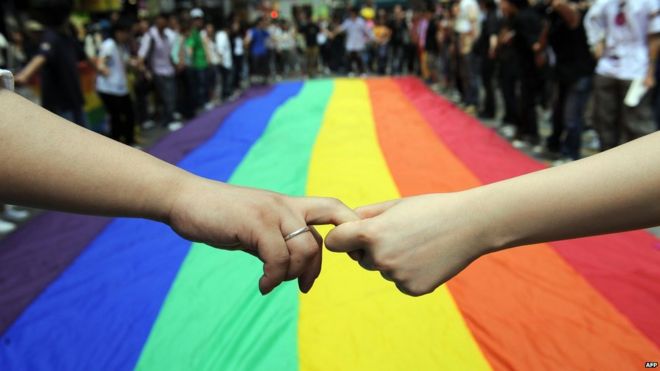
People holding hands in a human chain around a rainbow flagIn the past decade, homosexuality has been understood and accepted as a choice of gender in many countries. However, there still is some hatred and discrimination against gayness in some part of the world and they even proposed theory that this taste can be retained.

According to “China: Gay student sues ministry over textbooks”, a university student decided to take legal action after found that some of textbooks in library indicate that homosexuality is a “disorder” and it could be cured by electroshock therapy. Actually, since 2001, China stopped distinguish gayness as a mental disorder, and these textbooks are printed after that year, so the student hope the court will order to remove the textbooks. One gay student also said this textbook make him horrified and scared.

When I read through this article, many different feeling was sparked in my mind. As I’ve already known that homosexuality is considered abnormality in Middle east, Russia and some Asian country, I’m not surprised that it was judged to be a mental disorder in their textbook. However, it attacked me with the fact that the therapy they suggested is shocking the patients with electricity, which is seem like the method that people in 100 years ago. I wondered what will be written in the textbook of the countries where being gay mean you will be sentenced to death ? I bet it will be much worse and harsher.

Another feeling is that, I just realize China just removed homosexuality out of mental disorder list in 2001. But, I assumed that many gays in China are still afraid to come out because of social value and social status. One of my friends told me that one of Chinese virtue for children are that they should reproduce in order to maintain their family bloodline. This means the gays will be considered ungrateful. (Actually, a few Thai parents still have the same belief that the boy who can’t enter the monkhood once in their life are fail to accomplish their role as a son).


Do you think what will happen next about Homosexuality discrimination in China and the rest of the world ? Will it getting better ? and what we can do to promote such changes since maybe there will be more “Rainbow Panda” in the near future?


__________Reference
China: Gay student sues ministry over textbooks, (2015, August 20). BBC News. Retrieved from http://www.bbc.com/news/blogs-news-from-elsewhere-34003679

Friday, 21 August 2015

Rumor or Truth?

As we all know about the bombing at Erawan shrine few days ago, it is sure that most of us not only Thai people but also the foreigners are quite concerned about this issue in terms of our safe. Nonetheless, are we sure that it is still safe under the announcement of the PM Prayut?

In the article "Investigation Into Bombing at Bangkok Shrine Widens" points out that there are at least 10 people who are involved with this situation because they had to work as a team to conduct surveillance, to find the materials and equipment, and to plan for the escape. Besides, Thailand's Prime Minister said this issue did not link to any international conflicts.

I am not surprised with the investigation,which had more than 10 suspected terrorists, but surprisingly, the PM told us that it is not involved with international tourism. How did he know? Are there any evidence to prove this? What are the reasons that we have to believe? or He know who are the bombers or the beginners of this panic situation? There are so many questions in my head, and I just suspected of something strange.

It seems that everything have been made to be the same. To illustrate, the polices cleared the Erawan shrine space less than 24 hours in spite of the fact that it had to be closed at least 2 or 3 days along with the BTS ways in order to investigate more evidences and enhance more security both BTS and MRT. If we compare with other countries which used to have the terrorisms, they would have much more security than Thailand. One important thing is to ensure people towards the unsecure moment.

Nevertheless, the terrorists have already made "the fear" into most people in Bangkok; in other words, they definitely succeed to their objectives. and the question is "do we have any strategy to get the fear out? or  "should the Thailand's authorities have any urgent policy to relieve people's fear?" I hopefully await some practical announcements from the government, or the polices other than watching the news through the online medias which mostly consists of same viral videos and photos, and unsure news about the bombers.

I still hope this situation is not involved with any international terrorism (No Uyghur, No ISIS), because it will be the first huge issue towards Thai people and government. Finally, I want to know what do the terrorists exactly want? what do they value (other than making fear to people)? This is not only the first time that Bangkok has the bombing in the center of city but it is the situation which have not occurred before under the navy government also.
  

Reference
Watcharasakwet, W (2015, August 20). Investigation Into Bombing at Bangkok Shrine Widens. WSJ News. Retrieved from http://www.wsj.com/articles/bangkok-bombing-probe-widens-1440060781

Thursday, 20 August 2015

Is Law right? Is it morally wrong to eat meat?

As we have just seen in our quick reading of the introduction to his essay "Carving the Roast Beast," Stephen Law's thesis is that "It's morally wrong to eat meat" (2003).

What do you think? Do you agree or disagree with Law? Is it morally OK or not OK to eat meat?

In a new comment, share your initial responses to Law's thesis.
__________
Reference
Law, S. (2003). Carving the roast beast. In The Xmas Files: The Philosophy of Christmas [Kindle Edition] (pp. 124 - 140). Weidenfeld & Nicolson.