Source background
As we have seen in all of our formal writing this term, the writing process for creating strong pieces of work involves a lot more than writing, which is only step 4 out of eight steps.
In exam, where you have limited time to produce a piece of writing, following a process remains very important. On page 56 of Skillful 3, Bixby and Scanlon present a short article on the topic of strategies for writing timed essays, which is also the title of the page (2016).
_______________________________________
As usual with these Study Skills pages, I think that they include some useful questions to help you think about your own habits, and they also offer very practical advice.
Respond to these questions:
For you, what are the three most challenging points on the list of seven that Bixby and Scanlon give at the top of page 56?
What do you think about the tips that they give in the Consider It section?
Which do you already follow?
Which don't you follow? Should you start following them?
Which are easy for you to follow?
Which could be more challenging for you? Why?
Do you think that they are all equally important?
Which one (just one) would it help you to focus on?
For ten minutes, write down your ideas in response to these questions.
___________
Reference
Bixby, J. & Scanlon, J. (2013). Skillful reading & writing: Student's book 3. Oxford: Macmillan Education
What I read
To practice the language of verb + preposition collocations in unit 5 of Skillful, Bixby and Scanlon have a question to respond to in exercise 3 on page 52.
_______________________________________
Discuss this question in a comment below.
Discuss a time you were drawn back to a place you had known in childhood. Describe how you found it again?
My first response was to misunderstand the question because I misunderstood the verb find, which has two very different meanings, both of which make sense in the question. See definitions 1.1 and 2.1 at the Oxford Dictionaries entry for find. In fact, the the example paragraph that is exercise 2 on page 52 uses both definitions of find.
You have ten minutes to respond to this prompt. I would spend a minute or two thinking for this response writing - first choose your topic; then respond.
___________
Reference
Bixby, J. & Scanlon, J. (2013). Skillful reading & writing: Student's book 3. Oxford: Macmillan Education
Source background On pages 50 and 51, we read and made inferences from the article "How Do Animals Navigate?", so we have read it very carefully to understand the ideas. Now, we want to reflect critically on it.
_______________________________________
As usual, Bixby and Scanlon give some specific questions to help us develop our critical thinking skills (p. 52).
Some sea turtles have been hunted for their meat and their shells for centuries. How can a better understanding of how turtles navigate help us protect these turtles? (Peter's first thought here was: should we protect them? Why not use our understanding to hunt them more efficiently?)
Homing pigeons apparently use roads and highways to navigate. What other animals might also do this? What problems might this cause?
For ten minutes, write down your ideas in response to these questions.
___________
Reference
Bixby, J. & Scanlon, J. (2013). Skillful reading & writing: Student's book 3. Oxford: Macmillan Education
What I read
Before we read "Invasive Species You Should Know", the first reading in unit 5 of Skillful, Bixby and Scanlon have a question to respond to.
_______________________________________
Discuss this question in a comment below.
What insects to you have in your area? What problems can they cause?
You have ten minutes to respond to this prompt.
___________
Reference
Bixby, J. & Scanlon, J. (2013). Skillful reading & writing: Student's book 3. Oxford: Macmillan Education
Source background
On page 47 of our text, Bixby and Scanlon introduce the topic of movement, which is again the title of of the unit. As usual, they open with a large photograph and some discussion points.
_______________________________________
Think about these questions for 30 seconds and then respond in a comment.
Look at the photo. Why do some birds migrate?
What other animals migrate? What animals migrate to or from your country?
What human activities can disrupt or interfere with animal movement?
Don't copy and paste the questions. This is response writing.
You have 10 minutes. Go!
___________
Reference
Bixby, J. & Scanlon, J. (2013). Skillful reading & writing: Student's book 3. Oxford: Macmillan Education
Source background On pages 40 and 41, we read and then summarized the article "Fire in the Sky", so we have read it very carefully to understand the ideas. Now, we want to reflect critically on it.
_______________________________________
As usual, Bixby and Scanlon give some specific questions to help us develop our critical thinking skills (p. 42).
Why do you think that fireworks are such a popular form of entertainment at celebrations around the world? What do you think they symbolize?
What are some other ways fire is used for holidays and celebrations in your culture? What about in other cultures you know about?
For ten minutes, write down your ideas in response to these questions.
___________
Reference
Bixby, J. & Scanlon, J. (2013). Skillful reading & writing: Student's book 3. Oxford: Macmillan Education
What I read In “Smaller, slower and sleeker: is the Toyota iRoad thefuture of city living?” Will Ripley reports the future of city vehicles that
have three-wheels and two-seats. iRoad
vehicles look like motorcycles but they are not, which have seats and safeties same
as cars. The vehicles can drive on narrow roads and park at limited slots. Those
use an alternative fuel that is electric plug-in form home electricity. In
order to people can save the environment, we should drive effective vehicles.
_______________________________________
My response
iRoad is an excellent innovation to save the world that can use everywhere
because it is small and fluent vehicle. Currently, many metropolises suffer horrible
traffic jam almost every day time that is the bigger problem to waste of times
and fuels. Especially, Bangkok, we spend too much time for commuter.
Moreover, not only traffic jam is increasing every day, but pollution
is going up ever day too. Thus we should use alternative energy more and more for
save the world. iRoad is a wonderful vehicle that does not release pollution to
affect the environment. Furthermore, it is a convenient vehicle too that can
drive and park everywhere same as a motorbike but comfortable like a car.
In the future, without
everyone drive effective vehicles, the world will be a terrible world such as atmosphere has a lots pollution and world’s temperature is higher than now. Who can deny an
important opportunity to save the world?
Source background On page 39, we read the article "Feeling the Heat"; again following the advice not only of Jennifer Bixby and Jamie Scanlon (2013), the authors of Skillful Reading and Writing 3, but also of Harvard's Stephen Pinker, we want to practice reading critically. What do we think about the ideas we have just read?
Can we expand on the ideas?
How do they apply to our own experience?
_______________________________________
As usual, Bixby and Scanlon give some specific questions to help us develop our critical thinking skills (p. 40).
What are some other dangerous jobs or types of jobs that require people to risk their lives? Why do you think some people choose dangerous jobs?
Kevin Lynch says that an important skill for firefighters is to be able to "stay calm when things are falling apart." Do you have this skill? Give examples to explain why or why not. If you don't have this skill, do you know someone else who does?
For ten minutes, write down your ideas in response to these questions.
___________
Reference
Bixby, J. & Scanlon, J. (2013). Skillful reading & writing: Student's book 3. Oxford: Macmillan Education
What I read
According to "What's the difference between idioms and proverbs?" (2013), although idiom and proverb contain the meaning that greater than its individual words, they have something different. An idiom is a group of word that "cannot be understood from the meanings of its individual words"; however, a proverb is a group of words that "gives advice about how people should behave."
_______________________________________
My response
I interested in this article because most of the time people usually say idioms and proverb together which make me thought that they are the same which is not true. "Be fed up with" is an example of an idiom; however, "to play with fire" is an example of a proverb.
Once I know the definition of idiom and proverb, it will be easier for me to use the word idiom and proverb correctly.
My mother usually says to me that "early bird gets the worm" because she wants me to wake up earlier than I does. In the past, I always woke up early especially for a holiday because I knew that there are a variety of cartoons waiting for me to watched which different from nowadays.
_______________________________________
Reference
What's the difference between idioms and proverbs? (2013, January 14). Learners Dictionary. Retrieved from http://www.learnersdictionary.com/qa/what-s-the-difference-between-idioms-and-proverbs
What I read
In "Should I pursue my dreams or get rich?", Xavier Tsai, a PhD student in Astrophysics , asks this question on the quora, which he means "Which one has more potential to make the world a better place?". There are many perspectives of the answers; some people suggest that he could compromise and do both things, some advice is that he should do research in his field in the early age and then he could go for the business when he's getting older. The most "upvoted" answer from Richard Muller, who is a Prof Physics at UCBerkeley and author of "Now-The Physics of Time" (Norton, 2016), is that "go for the money" because the research is only for people who don't have other things to do and addict in each field. This is not a path toward to happiness, job security or well-paid.
_______________________________________
My response
This question also was coming up in my mind when I have decided to study a master degree. I definitely want to learn in programming because I love to do and I think that I would affect the world in the future in many fields. In addition, my goal is I want to create the innovation in medication field which would help other people to be a better situation than they used to be. There are 3 options that I have to decide which way I want to go with.
The first one is working as the researcher, this would spend me many hours in the lab and university to do the research. Second, going to work as a programmer as professoinal carrer whether join start up project, or create it with co-founder, to create the health care innovation. This way I think it is tough than the first one because it would use a lot of money to have an innovation and the period is at least three years in development process, this is not include launch to the public as trial and error.
However, I don't want to go with the first option; when I imagine that I have worked as the researcher in the university, I feel that it would not happy. I don't know how exactly to describe but I think everyone can feel with one we would make you happy ,which one is not.
My last options is that I just do some businesses and get rich. Then use that money to support the medication innovation. This option is still hard to accomplish since I have to get very rich and have money left to go for something else that not provide you the money and your business have to run without struggling.
Currently, I stil trend to go with option two and still look forward to create some business that can provide me money. This is long way to go and I believe I could do it one day down the road.
How about you guy, what is your idea about this one? If you had to answers his question, what would be your suggestion?
Source background
On page 37 of our text, Bixby and Scanlon introduce the topic of fire, which is again the title of of the unit. As usual, they open with a large photograph and some discussion points.
_______________________________________
However, this time, instead of inviting us to discuss a couple of questions, they begin with an exercise checking the actual meanings of several English sayings that talk about fire.
These English sayings are:
to play with fire = "to become involved in a dangerous situation"
to jump out of the frying pan into the fire = "to go from one bad situation to a worse one"
Where there's smoke there's fire. = "If something bad is being said about someone or something, it's probably partly true." and
to come under fire = "to be criticized"
Two questions to respond to are:
Do you have any sayings about fire in your first language? What are they? Explain the meaning.
Think of a story, situation or experience that can be explained by one of the expressions above. Use the expressions to explain it to a partner.
You have 10 minutes. Go!
___________
Reference
Bixby, J. & Scanlon, J. (2013). Skillful reading & writing: Student's book 3. Oxford: Macmillan Education
Source background
As we have seen cultural and personal attitudes to what it is OK to copy from others vary across cultures and between individuals, although most people probably sometimes give in to the temptation for a bit of easy cheating by stealing. However, this is never acceptable in academic work. Learning how to avoid plagiarism is one of our important purposes in the weekly blogging we do.
Following their writing task on page 35, on page 26 of Skillful 3, Bixby and Scanlon present a short article by Stella Cottrell on the topic of plagiarism, something we have already looked at and an issue that every good university takes very seriously (2016).
_______________________________________
I think that everything Cottrell says is useful, from her definition in the section "What is plagiarism?" to her very practical tips on how to break the habit of copying.
How common is plagiarism at schools or universities you have attended?
What did you think was most useful in Cottrell's article?
Do you think you might change any of your habits now that you have read her article?
For ten minutes, write down your ideas in response to these questions.
___________
Reference
Bixby, J. & Scanlon, J. (2013). Skillful reading & writing: Student's book 3. Oxford: Macmillan Education
From the 1962 film version of To Kill a Mockingbird
What I read
In "To Kill a Mockingbird removed from Virginia schools for racist language," Danuta Kean reports on the controversy surrounding recent bans by some US school districts of classic works of modern English literature, with parents groups arguing that the racist, sexual or religious content disturbs their children, while free speech advocates strongly oppose such banning of upsetting books, arguing that they raise important issues for children to discuss (2016).
_______________________________________
My response
I agree completely with the free speech advocates who oppose banning books. I also agree that it is deeply offensive to see words like nigger, faggot (an extremely offensive term for gay men), cunt (for women), and so on. But being offended, is not a good reason to keep people in ignorance of reality by censoring and banning. If the possibility of offending someone were a good enough reason to ban something, it's hard to see what would not be banned. I find much religion offensive, and religion, especially Christianity, did much actual harm to me and millions of other children by teaching us lies about homosexuality and about sex generally. So, if offensive content is a good reason to ban books or ideas, the Christian Bible, and the Jewish Bible, must be banned along with the Islamic Quran. But that is wrong. The better solution is to let the hate speech be spoken so that the false and immoral ideas can be proved false and immoral in healthy public debate, where the law protects everyone's right to have and to state their ideas.
In the meantime, children should not be denied great literature because their parents, or some other parents, are scared it will upset or corrupt them. I wonder: is it so bad to be upset by learning truths about human society? Humans are part of nature, and like the rest, we are often nasty, cruel and uncaring of others. We treat other species even worse as we cause them to suffer for short awful lives before we kill them so we can enjoy eating their flesh. I think the best way to avoid this is to learn how truly barbaric humans can be, and then we know what has to be fought against: sexism, racism, speciesism, anti-gay laws that do not, for example, allow same-sex marriage, and other prejudices are all morally wrong, but pretending they don't exist is not a healthy response and seems to me unlikely to make society better. To Kill a Mockingbird did a lot to improve white awareness of racism in US society in the 1950s, and it still has much to offer today. To ban it because the author uses the right language is a serious mistake. And I rather enjoy reading the Bible - it has some great literature in it that I don't want to see banned. Shakespeare's Romeo and Juliet? Well, yes I can see why parents don't want their young kids reading that exciting story of silly teenage love full of sex and violence, but Shakespeare teachers us something important about being human as Romeo throws away the old girl friend when he sees the much sexier Juliet, who is a ripe 13 years old!
The related problem with banning things is that it is deeply anti-democratic: to protect our own rights, we must protect the same rights of those who say things we hate.
Source background
In our version of the writing process for academic work, we don't stop at step 4, writing, which is in fact only half way through the process of producing a strong piece of academic work. The following editing steps 5, 6 and 7 are also important, which is why good writers tend to spend time on these editing steps.
On page 26 of Skillful 3, Bixby and Scanlon present some concrete ways that these steps can be done (2016).
_______________________________________
Some questions to respond to:
How do you edit or proofread your own writing?
Why do you think it is important to become skilled at editing and proofreading? (Is it important?)
read the five tips from Bixby and Scanlon.
Which ones have you used before? Did they help your writing?
Which ones would you like to try? Why do you think it will help your writing?
For ten minutes, write down your ideas in response to these questions.
___________
Reference
Bixby, J. & Scanlon, J. (2013). Skillful reading & writing: Student's book 3. London: Macmillan Education
What I read
In "Learning to love the secret language of urine", Reisman discussed using urine in diagnosing patients. Because he had been inspired by a nephrologist to study "urine's subtle language," he learned more about urine. He claimed that urine can tell him the problems not only of urinary track infection but also of other parts of the body. He averred that urine is one of the most indicators for him to patients' problems.
_______________________________________
My response
Although this is a weird topic, its weirdness has attracted my attention. Reisman thought that his job in "urinalysis" is like a sommelier. I don't know what did he have in mind. One thing for sure is that he is lucky that he weren't born in the time that physician still had to taste urine. The idea is just disgusting.
Save for the idea that physician in the past had to taste pee, I quite like the idea of urinalysis. According to Reisman, urinalysis can tell more about our health condition than merely urinary tracks infection. This will help us to prevent our disease from an early stage. If urinalysis can detect possibility of cancer, humans will get a lot of benefit from the advancement. Say, if I wanted to know whether I have cancer, given that the accuracy is the same, I would do urinalysis because it would definitely cheaper, and it would be easier. Besides if it's easy then it can be included in annual check-up program.
Recently some of my relatives have fallen sick. Although they went for annual checkup every year and always resulted in healthy, they are not actually as healthy as the result showed. I just think that it would be better if doing all the analysis is so easy that every program can be included in annual checkup in an affordable price. I am not really sure how could it work.
When I was studying in college, I attended a lecture about health care market in southeast Asia. I was told that Thailand's hospital has either largest or second largest market capital in the area. The future was really good. It's still good now. However, when we focus on medicine graduates, they have to struggle even after graduation. Without having connection, the path of success is more or less sealed. Physicians don't think of the welfare of patients as the priority. I think the situation in Thailand might be aggravated in the near future.
_______________________________________
Reference
Reisman, J. (2016, November 23). Learning to Love the Secret Language of Urine. The Washington Post. Retrieved from https://www.washingtonpost.com/opinions/learning-to-love-the-secret-language-of-urine/2016/11/22/f9c09914-adac-11e6-a31b-4b6397e625d0_story.html?utm_term=.9aa2f75eaad4
What I read
On quora website, which is the website for questioning and answering by its community of users, This question was asked:"What are the biggest facepalm moments you have ever experienced?". Sean Kernan answered this question that it's happened every time when he visits Yahoo Answer website, he's also captured those questions and share with us. Followings are the examples of them.
_______________________________________
My response
I read this in the morning on the subway and I think it is actually true and so fun. So I just want to share it to all of you. I got the same experience likes Kernan. When I tried to search some information and I visited Yahoo answer website, there are some ridiculous answers there.
This also reminds me of Pantip website. Even though it is a very good website and I used it a lot when I need some information about products, restaurant, and travel places, there are some ridiculous questions also; Asking about the name of song, for example, many years ago before Shazam app alive, there are the questions likes "what is the song's name that song's rhythm are "Sha Da Di Da Sha Saa"" I think how we know the answer but there is someone know the answer. How that person know? This is the question that I mean.
Another fun question is "How much the tuition cost in Hawkward"; When I read those questions, it is so fun and I was laughing. I asked the question to myself why those people asked the questions like that. They just want to make other people laughing or they seriously want to know the answers.
By the way, What are biggest facepalm moments that you have ever experience?
What we are about to read In a few minutes, we are going to read "How Does the Brain Multitask" (Bixby & Scanlon, 2013, p. 31), but first, we want to get our ideas on the topic.
_______________________________________
Discuss this question in a comment below.
Think of three examples of multitasking from your daily life. Which situation is the easiest for you? Why?
You have eight minutes to respond to the question.
___________
Reference
Bixby, J. & Scanlon, J. (2013). Skillful reading & writing: Student's book 3. London: Macmillan Education
Her doctor attributed her longevity to the fact that she is cared for by loved ones. Image and caption: The New York Times
What I read
In "Emma Morano, last person alive born in 1800s, turns 117" (2016), Agence France-Presse (AFP) reports on the life and upcoming 117th birthday of Italian Emma Morano, who was born in 1899 and it still alive in the 21st century, although now bedridden in the home she has not left for 20 years. AFP suggests that Emma attributes her long life to a diet of mainly eggs and cookies, but also noting that she has kept herself independent and lived alone since she got rid of an abusive husband in 1938.
_______________________________________
My response
I don't normally blog articles from the Bangkok Post, but that is where I first saw this story, which the Post got from its AFP news provider. I subsequently saw the BBC News and New York Times versions of the story, and I'm sure many other daily newspapers around the world wrote it up. Naturally, people are interested in the "secret" of growing so old, and there was a bit of variation there: all the sources I read report that Mrs. Morano lives mainly on eggs, preferably raw, but the number of raw ones varied a bit. The New York Times (NYT) account, "Emma Morano, World’s Oldest Person, Turns 117" (2016), explicitly says that "she believed that her secret to longevity was eating three raw eggs a day and remaining single," while the BBC News story at "World's oldest person Emma Morano celebrates 117th birthday" (2016) has her attribute her 117 years to "a rather unusual diet of three eggs - two raw - each day for more than 90 years." It was a minor detail, but one that I noticed in reading the different news coverage. I don't have a very high opinion of the Bangkok Post's news reporting, but AFP has an excellent reputation, and I'm inclined to agree with their version as reported in the Post. The NYT's writer seems to have drawn on his earlier interview with Mrs Morano, and that might have been exaggerated a little.
I thought that the variation was interesting because it also connects with a point that has come up in some of your recent blogging, and which one of the questions we responded to from Skillful yesterday asked: "How do you know the information you find on the Internet is accurate?" This question, of course, does not only apply to the Internet - there is rubbish published in the print edition of the Bangkok Post every day which, while perhaps not outright lies, gives a seriously false image of domestic Thai politics and the society that produces those false images for the captive domestic Thai audience. And during the recent US election, concerns were raised about the competence of citizens to sort fact from fantasy on Facebook, as Den has already written on.
Finally, apart from the raw eggs, the thing that most attracted me in Emma's story was that she has been alone and independent since 1938, after getting rid of her rotten husband. That's almost 80 years of living alone! I like it because it takes courage to to that, especially for a woman of her generation, when social values and attitudes were much less morally developed than they are today. I've lived alone for most of the 40 years since I left home to study at university, and I rather like it, as Emma seems to. I'm not sure how I would feel if I were twice my current age: perhaps I'll get a chance to find out.
I was also reminded of my own 86 year old mum, but ... my coffee has come to an end.
Edited 8:47 AM - an addition
I would normally put any later thoughts in a comment, as I already have, but I can't show the YouTube clip in a comment, so have added it here.
I often multitask by listening to music on YouTube as I'm getting dressed. This morning, I was reminiscing to some Freddie Mercury and Queen when "Living on My Own" came up. Freddie's lyrics directly contradict what I wrote in my response above: although I've lived alone for most of my life, I've rarely felt lonely. The timely coincidence was a good excuse to include a sample of the work of one the greatest ever rock singers in my blog post. I hope you enjoy it.
Source background
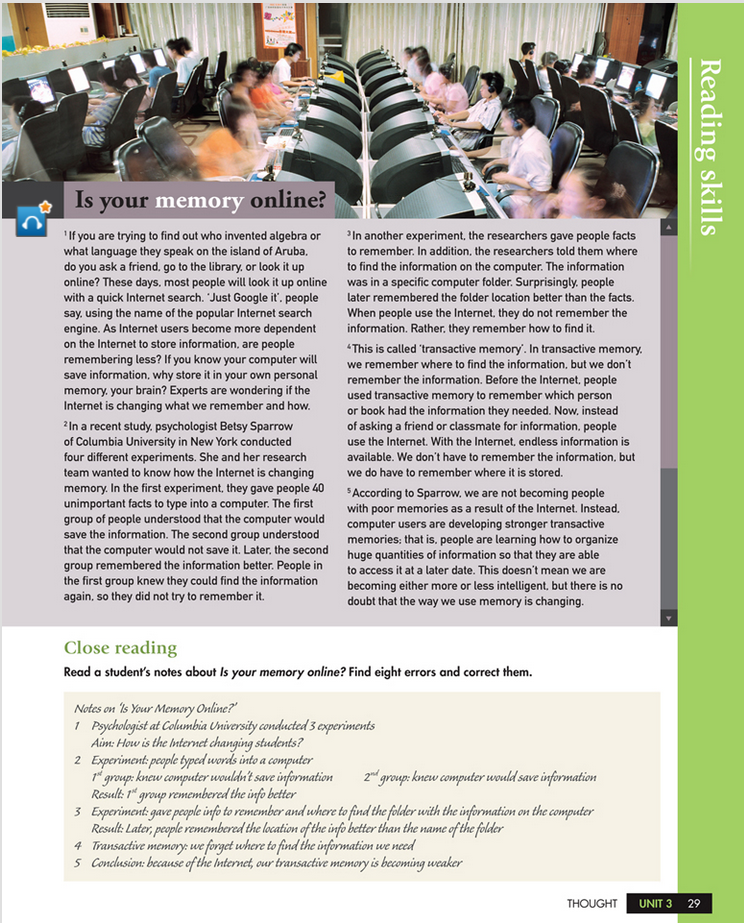
On page 29, we read the article "Is Your Memory Online?" And following the advice not only of Jennifer Bixby and Jamie Scanlon (2013), the authors of Skillful Reading and Writing 3, but also of Harvard's brilliant Stephen Pinker, we want to practice reading critically. What do we think about the ideas we have just read? Are they clear? Do we agree with them?
_______________________________________
As usual, Bixby and Scanlon give some specific questions to help us develop our critical thinking skills (p. 30).
What kinds of information do you think it is good to let the internet "remember" for you? What kinds of information do you need to remember?
Do you think that you remember the location of information (where to find it) better than the actual information? Why or why not?
For ten minutes, write down your ideas in response to these questions.
___________
Reference
Bixby, J. & Scanlon, J. (2013). Skillful Reading & Writing, Student's Book 3. London: Macmillan.
What I read
According to "Your Name review – a beautiful out-of-body experience", Mark Kermode said Your Name has been popular in Japan for months. This movie is a story of switching soul between a high-school girl named "Mitsuha", who live in urban area and want to become a boy, and a young man named "Taki", whose quite popular in Tokyo. Mark Kermode said that teenager will find this movie as a love story like "Romeo + Juliet"; while, older viewers will delight that old fashion arts have become more modern in 21st-century because this move is a combination of "the ancient and modern" like "Treasure the experience.”
_______________________________________
My response
I saw this movie this month after I came back from Chiang Mai. At first, I didn't realise that it's a romantic movie, I went there because my boyfriends wanted to see. He said that this is a great movie; however, I don't think so.
The day after we watched this movie, the amazing things happened. I can bought a copy version of this movie through DVD which exactly the same as I watched. This is one kind of crime that many people didn't realised. They just think that this is a normal things that everyone do may be because they don't have any effect from this action.
This action can effected with many things such as sales of the company or reputation of the country.
If many people think that this is a normal things, in the long term no one will want to create new things. They will wait to copy other people's idea which is hard for Thailand to grow as a developing country in the future.
A question come up in my mind is that how can companies prevent this action and make a long term profit in the future? This is a serious question for companies because it's easily for companies to bankrupt, if they don't have solutions for this problem.
Etude is a Japanese brand that used to sell cosmetics in Thailand and bankrupt in the next few years because Japan is not far from Thailand. That's why many people bought Etude's product from Japan and resell it at a cheaper price in Thailand.
_______________________________________
Reference
Kermode, M. (2016, November 20). Your Name review – a beautiful out-of-body experience. The Guardian. Retrieved from https://www.theguardian.com/film/2016/nov/20/your-name-review-makoto-shinkai