Thursday, 20 September 2012

Rich Rewards Richly Deserved

I never think of myself as poor, but in comparison with the world's super-rich, I am pretty poverty stricken, as a story in the BBC News has just reminded me.

According to "Bill Gates Tops Forbes Rich List for 19th Year", the list of America's wealthiest people is largely unchanged from a year ago, except that most of them are much richer than then, with their total assets having increased by 13% (2012).

Although he is vastly richer than I am, I do not feel any envy of Bill Gates, who tops the Forbes list for the 19th year running. Some people only inherit great wealth, or steal it through corruption, war and other crimes, and never do anything to honestly and justly acquire it, but Bill Gates and his fellow members of the Forbes list are not like that. He is rich because he has created enormous value for billions of other people, and these people, including me, are very happy to pay him a few dollars each for the value he gives in return. For example, I am writing this on a computer running Microsoft Windows 7, for which we must thank Mr Gates, and I have been using Windows, MS Office and other programs productively and enjoyably for many years now. I've always been happy to do the right thing and pay Mr Gates for the value he has contributed to my life through his products. I don't want to steal from him by using illegal software. He might not need my little bit more, but he deserves it more than the criminals who make, sell and buy pirated software, DVDs and the like.

I think most, if not all, of the super-rich Americans made their wealth honestly through fair competition in free markets by providing real value to millions, often billions, of happy, satisfied customers. This can be seen in the large number of technology billionaires on the list, including poor Mark Zuckerberg, whose fortune has dropped by nearly half, but he's still 36 on the list with more than $9 billion. Zuckerberg, like Gates, has also earned his extreme wealth by creating immense value for almost one billion users of Facebook, who don't even have to pay for the product they use so very often.

The other thing that always impresses me about a lot of these very rich people, again, the honest ones, not the selfish, worthless type, is their extraordinary generosity, their eager philanthropy. The two richest people on the Forbes list are also the two most philanthropic people on earth, having given away billions, in Bill Gates' case something like $30 billion, to help millions of truly poor people around the world. What a wonderful example they set: having contributed so much to the world through the value they created, they then give selflessly to benefit others.
__________
Reference
Bill Gates tops Forbes rich list for 19th year. (2012, September 19). BBC News US & Canada. Retrieved September 20, 2012 from http://www.bbc.co.uk/news/world-us-canada-19652594

Wednesday, 19 September 2012

Free Market Rules

I wasn't thinking of international business when I was browsing the BBC News yesterday, but the the title "South Korean Host Bars - for Women" did catch my eye, and when I read it, I realised that it is relevant in several ways to the ideas we will be looking at in the first chapter of Quest.

Red Model Host Bar, Seoul. 
In this article, Lucy Williamson reports on the recent rise in traditionally conservative South Korea of host bars for women who want handsome and attentive male company, whether for sex or simply companionship, and are happy to pay the young men a lot for it (2012). According to Williamson, these host bars attract wealthy and, increasingly, women with high social status, for reasons varying from a desire to control men, to wanting someone to listen to them.  Williamson also says that these bars allow Korean women to "challenge traditional gender roles and flex their economic power" in a rapidly developing economy.

I guess that when most of us hear the phrase host bar, we think of men, probably older men, going to places with attractive young women, so when the next words in the BBC News's title were "for women", I thought it might be worth a look. It was. Actually, I've heard of the same thing happening in Bangkok for wealthy, hi-so women who want a handsome young man and who prefer not to visit the numerous gay bars and cocktail lounges in Bangkok. I'm sure it also happens in Australia and every where else. What made it more interesting in this case was, as Williamson reminds us, the fact that traditional Korean society is seen as more conservative than modern American or Australian society, where such things are sort of normal and accepted these days, although when I was a child growing up in rural Australia, prostitution and such things were all very secretive, and illegal.

Sadly, their citizens most private and personal activities, their sex lives and intimate relationships, is something that too many governments take far too much interest in, and almost always for bad reasons, with seriously unjust results. Today, prostitution is legal in Australia, although brothels selling sex remain illegal in the more conservative western states. I think this legalisation has been good for Australian society, for men and women working in the sex industry, and for their customers. It has greatly reduced the police and other corruption that used to exist. It has also made life much safer for male and female sex workers, who can now go to the police if they are abused by customers or employers, and the same for customers in these legal businesses. The related health problems are also much improved. And of course, the sex industry now pays its taxes like every other industry. Finally, I think that it makes the whole society more honest when we can be open and admit how human beings feel and behave, and allow adults to freely agree to do things that do not harm other people against their will. As usual, less government control has been very good for Australian society and citizens.
__________
Reference
Williamson, L. (2012, September 18). South Korean host bars - for women. BBC News magazine. Retrieved September 19, 2012 from http://www.bbc.co.uk/news/magazine-19570750

What the Public Wants?

As we saw in the short reading from NPR, food customs vary greatly around the world. Some people think it's OK to eat horse, whilst others would never do that unless forced. Reading the BBC News with my morning coffee yesterday, I came across an article with similar ideas on cultural differences.

According to Guy Lynn in "Cane Rat Meat 'Sold to Public' in Ridley Road Market", butchers at a major meat market in London sell large quantities of a type of African rat, other bush meat, and illegally prepared sheep and goat meat (2012). Lynn reports that a BBC investigation discovered these sales, which the shop owners subsequently denied, and that local government officials had done nothing to stop this criminal activity. The article says that local councillor Feryal Demirci told the BBC team that they "have only received a single complaint regarding the sale of illegal meat" since 2009, and that that report was not proved.

It was the words "cane rat meat" in the title that caught my eye because this reminded me of visiting villages in Sukothai and other provinces where rat from the rice fields was on the local menu. I wasn't keen to try them myself, but they looked perfectly clean and, I guess, edible. They certainly seemed popular with the local villagers, who did kindly offer to share the plumb fur balls they had caught. And that reminds me of visits Chiangrai, where dog seems always on the menu. The first time I visited, I was travelling with my youngest brother, and we had popped into a restaurant in a small town for lunch. We couldn't read the menu, but the helpful owner or cook suggested a few dishes, including a duck dish. When the duck arrived, it tasted fine, but seemed a bit odd: the bones were not like duck bones, and the taste, even with the added spices, didn't seem quite normal. A few questions clarified the confusion: the owner had not been saying "duck", but "dog". Dog certainly seemed right. But we'd already tried it, so continued with our meal, although we might not have chosen that particular dish had we not misheard the main ingredient.

That's my personal memory that interested me in the story, but it also reminded me of a more serious social and political issue: the unhealthy amount of government interference in people's lives. As proven from the almost daily evidence against current Thai drug policy, when governments unjustly try to control people's personal decisions, the result is usually a total failure that benefits only corrupt police and other officials, and mafia gangs. The same thing happens in the illegal meat trade. People obviously want to eat rats and other bush meat, and making it illegal for no good reason does not stop them. The result is obvious. When something that harms no one else is made illegal, people happily break the law and buy rats from Ghana, heroin from Burma and wine from France. The sensible, just, and most practical, solution is to legalise all of these things and only punish real crimes. If rats sales are legal, then respectable business people will do it openly and standards can be properly regulated, making it safer for buyers and society. If the "smokies" (sheep prepared by blow torching off the fleece) are legal, the meat can again be legally tested for safety, better protecting consumers than is possible whilst the practice is a criminal offence. And of course, if these things were all legalized, they can be taxed. Legalization, as usual, leads to a lot of benefits and to no harm.

The strange thing is that so many people continue to support unjust laws of this type. How many people, for example, oppose the perfectly immoral Thai and US laws, among many such, that irrationally and hypocritically criminalise some recreational drugs and not others? All these unjust laws do is cost tax payers an enormous amount for a complete failure, encourage corruption, harm citizens and their children, and profit mafia groups. This seems both immoral and a very silly to me. It's much better for society and individuals to treat adults as adults. If they want to eat rats, let them and protect them.
__________
Reference
Lynn, G. (2012, September 17). Cane rat meat 'sold to public' in Ridley Road Market. BBC News London. Retrieved September 19, 2012 from http://www.bbc.co.uk/news/uk-england-london-19622903

Tuesday, 18 September 2012

Reading the Future

In their paragraphs about a current passion, a couple of people wrote about reading, and this has also been one of my constant pleasures since I was around ten years old. But with the rapid rise of technology, do books and reading have a future?

The BBC News article "Digital Fiction Book Sales Soar, Publishers Association Says", says that even though paper books are not becoming more popular, digital books are rapidly gaining in popularity with readers in the United Kingdom: sales more than doubled from one year ago (2012). According to the article, publishers think that strong intellectual property protection has encouraged publishers "to invest in exciting authors and titles", but they are not sure what might be popular in future.

I agree with the article that reading will remain an important pleasure for many people, but I'm less sure about paper books. They might be holding steady for now, but I think that the paper versions could very quickly die out. I remember that when digital photography arrived, everyone thought that film would always continue and be better. This was true for a while, but then the digital version became so good, so much cheaper and so much more convenient that film and film cameras just disappeared overnight. Do you use a film camera today? If you were interested in photography as a hobby, would you even think of buying a film camera?

I've always loved books, and have thousands of them in Australia and thousands more that I've collected since I settled in Bangkok. If you had asked me about eighteen months ago, I would have said that I would never prefer a computer version to a "real" book. But then a year ago, I tried a friend's Kindle. Then I was reading in bed one night and had to use a dictionary. That was the decisive moment! When I'm working at my computer, I have the wonderful and massive Oxford English Dictionary available online, along with the excellent Oxford Advanced Learner's Dictionary. They are quick and easy to use. In contrast, when I was lying in bed with my book, I had to put the book down, risk losing my page, reach over for the 2 kg Concise Oxford English Dictionary sitting on my bedside table, find the entry, and then read the tiny print. It was a real pain. The dictionary is heavy enough to exercise the arm muscles more than I want, and it's a long, messy business. My friend's Kindle had the excellent Oxford Dictionary of English included to automatically look up words! (I'm a fan of the excellent Oxford range of dictionaries.) The next day, I ordered my Amazon Kindle. I love it! Over the past year, I've bought more than a hundred new books, but only three or four paper books.

I'm sure that the future of reading is bright. But I think paper books might be heading into the darkness of museum exhibits.
__________
Reference
Digital fiction book sales soar, Publishers Association says. (2012, September 17). BBC News Technology. Retrieved September 8, 2012 from http://www.bbc.com/news/technology-19626076

Sunday, 16 September 2012

Welcome to Reading and Writing 3, term 6, 2012.

Thank you for registering for the Reading and Writing level 3 class in AUA's Academic English Program (AEP).

Over the next six weeks we will be working through two or three chapters in Hartmann's Quest 2 Reading and Writing [Quest] (2007), which might already be familiar to some of you from level 2 last term. As usual, we will be doing both a a bit more writing than Quest asks for and a bit more reading.

And this being 2012, we will be using the tools that are normal in modern academic institutions: email, the internet and so on; academics and students no longer submit their written work on scraps of paper, and we won't be doing that either.

I hope that you find the class both enjoyable and challenging so that our six weeks together will be productive and pleasant.

And if you ever have any question about anything, please feel welcome to ask us in class, email me, or write it up here on our class blog (Peter, 2011). 

__________
References
Hartmann, P. (2007). Quest 2 Reading and Writing, (2nd. ed.). New York: McGraw-Hill.

Peter. (2011, February). AEP, Blogging our class. Class Blog - AEP at AUA. April 22, 2012 from http://peteraep.blogspot.com/p/blogging-our-class.html

Monday, 3 September 2012

Religious Art in Our Cultures

Having read "The Sacred Realm of Art" (Hartmann, 2007, pp. 78 - 79), we now want to follow up Hartmann's invitation and suggestion in the discussion exercise F. on page 82 that we apply the same sort of analysis to our own cultures; we will do this as a response writing exercise here.

Hartmann's three prompt questions, slightly revised, to get us thinking are:
  • What kinds of religious art can you find in your culture? (Sculpture? Paintings? Architecture? Other?)
  • What are some topics of this art? 
  • Does this art make the religion more visible? Explain your answer. 
Since this is a response writing activity, a discussion rather than an academic essay, feel free to share your ideas as you like. 

__________
Reference
Hartmann, P. (2007). Quest 2 Reading and Writing (2nd. ed.). New York: McGraw-Hill.

Thursday, 30 August 2012

Do Thai Governments Help Thai Farmers?

Although the unjust policy of making the sale and use of some recreational drugs illegal is popular, the obvious facts, which we see in the news every day, prove that after more than 40 years it is and always has been a total failure.

Similarly, their constantly poor and powerless condition after decades of government control of their economic decision making seems to be strong evidence that Thai governments do not help Thai farmers.
  • What do you think? Do Thai governments help Thai farmers? 
As discussed in class, this question arose out of the desire of several people to discuss such issues in their essays answering Hartmann's question on page 60 of Quest: "What is the economic system in one country you know?" (2007)
__________
Reference
Hartmann, P. (2007). Quest 2 Reading and Writing (2nd. ed.). New York: McGraw-Hill.

Comparing works of art. Quest 2, p. 90 - 91

These are the works of art on pages 90 - 91 of Quest 2 (Hartmann, 2007).

The Lamentation,
by Master of the Codex of Saint George, c. 1340 - 45.

The Death of General Wolfe, by Benjamin West, 1770.

Cooling Off by the Riverbank,
by Kitagawa Utamaro, late 18th century.

In the Omnibus, by Mary Cassatt, 1891.


__________
Reference
Hartmann, P. (2007). Quest 2 Reading and Writing (2nd. ed.). New Yok: McGraw-Hill.

Wednesday, 29 August 2012

Art as the Mirror of Everyday Life. Quest 2, p. 85 - 87.

These are colour images of the works of art discussed in "Art as the Mirror of Everyday Life" (Hartmann, 2007, pp. 85 - 87)

Court Ladies Preparing Newly Woven Silk, by Zhao Ji, China, 12th century

Février des Très Riches Heures du Duc de Berry
Illumination by the Limbourg Brothers, France, early 15th century.

Count of the Cattle, Tomb of Meketre, circa 2000 B.C.E.


John Brown Going to His Hanging, by Horace Pippin, 1942.

__________
Reference
Hartmann, P. (2007). Quest 2 Reading and Writing (2nd. ed.). New York: NcGraw-Hill.

What's the Story? The Sacred Realm of Art. Quest 2, p. 72 & p. 78 - 79.

These are colour images of the works of art discussed in "Looking at Art: What's the Story" (Hartmann, 2007, p. 73) and "The Sacred Realm of Art" (pp. 78 - 79)

"Cult" Stand, Statue Anthropomorphic, Painted
800 - 600 B.C.E.

For more information see "Cult" Stand, Statue Anthropomorphic, Painted at http://www.antiquities.org.il/t/Item_en.aspx?pic_id=1&CurrentPageKey=106

____________________________________ 

Standing Figure Holding a Baby,
Olmec, 800 - 500 B.C.E.


Bwa tribal mask and costume. Burkina Faso.
Bwa tribal mask. Burkina Faso.

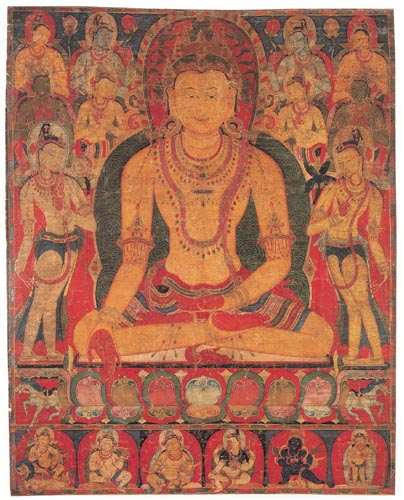
Tathagatas Ratnasambhava,
Central Tibet, ca. 1200-1250
This is a different version of the work discussed in Quest, which I was unable to find. I think it's similar enough not to matter. I'm not sure that the reference information given in Quest is correct (p. 270). For more information, see Three Tathagatas at http://www.asianart.com/exhibitions/svision/i23.html 


Madonna Enthroned
by Cimabue. c. 1285.
For more information, see "Santa Trinita Maestà" at http://en.wikipedia.org/w/index.php?title=Santa_Trinita_Maest%C3%A0&oldid=485139381


__________
Reference
Hartmann, P. (2007). Quest 2 Reading and Writing (2nd. ed.). New York: McGraw-Hill.

Monday, 27 August 2012

Art: Themes and Purposes. Quest 2, p. 71 - 75.

For the rest of the term in Quest, we will be reading about and discussing art.
Painting Van Gogh by T. F. Chen, 1991
An obvious first question might be: What is art?
However, Hartmann limits her discussion to a much narrower set of art: the visual arts, starting with the image above on the opening page of chapter 3, and we too can probably ignore the difficult question of what art is, even if we do not limit ourselves here to the traditional visual forms of art that are the subject of chapter 3 of Quest (2007, p. 71 - 104).

The questions to respond to in your initial comments are:
  • What is your favourite work of art? Why do you like it? (p. 71) You need not limit yourself to visual art in responding to this question. 
  • Look over the pictures on pages 74 - 75. Which one do you like the most? Why? Do you know something about any of these pieces of art? (p. 72)
    I've been able to find better copies online, as below. Click on the picture to open a larger version of the image. 
There is no need to do any research or reading to respond to these questions. Just write down your ideas. You might prefer to write two separate comments, and you are of course welcome to also reply to earlier comments.
The Art Critic by Norman Rockwell, 1955 

Aquila degli Abruzi
by Henri Cartier-Bresson
, 1952.

Street Scene, Haiti, by Laetitia. 20th C.
__________
Reference
Hartmann, P. (2007). Quest 2 Reading and Writing (2nd. ed.). New York: McGraw-Hill.

Monday, 20 August 2012

Food Customs: Bitter or Sweet?

We started class on day one looking at the first paragraphs of an article about eating horse meat, according to which eating horse is a traditional custom in some cultures, although many Americans find it distasteful and do not approve (Burnham, 2012; Peter F AUA, 2012). Similarly, over recent months, there have been reports about the arrest by police of groups smuggling dogs from Thailand for the dining tables of Vietnam, which suggest that at least some Thai people are not happy with the idea of eating dogs ("700 Dogs", 2012), although killing, cooking and eating dogs is also a traditional custom in Thai culture, a custom which continues in some regions of Thailand today, at least in the north around Chiangrai and Chiangmai ("Dog Meat", 2012). I believe that the provinces of Sakhon Nakhon and Nakhon Phanom are also known to continue this Thai tradition.

More generally and controversially, there is disagreement about whether meat should be eaten at all, especially in Buddhist cultures. According to the First Precept of Buddhism, followers of Buddha agree "to abstain from taking life" ("Five Precepts", 2012). Some Buddhists, including groups in Thailand, interpret this as meaning that they must not or should not normally eat meat, since that must cause animals to be killed; however, other Buddhist groups, including most in Thailand, interpret this precept to allow most sorts of meat to be eaten by Buddhists ("Buddhist Vegetarianism", 2012). In the case of Jews and Christians the dietary rules in the Bible are perfectly clear: most animals can be killed and eaten, but some, including pork, prawns and other shellfish, and few other animals may not be eaten (Lev. 11). The Qu'ranic injunction against pork for Moslems is well known (Surah 2:173).

Please share your responses in a comment below.
  • Is it OK to eat every kind of animal? If some but not others, why not? 
  • Is it OK to eat any kind of animal? Why? What makes it OK? 
  • Is it wrong to eat every kind of animal? Why is it wrong? 
  • Should the government make laws about what animals may and may not be killed for human food? 
  • Or should people be allowed to eat any animal they want to? (And which is their own property).
  • ? These are just some suggested questions you might like to respond to, but this is a response writing activity, so feel free to write down whatever ideas come into  your head in response to this post, to the sources I've cited, or to your classmates' earlier comments. 

__________
References
700 dogs rescued from smugglers. (2012, July 29). The Nation. Retrieved August 20, 2012 from http://www.nationmultimedia.com/national/700-dogs-rescued-from-smugglers-30187191.html

Buddhist vegetarianism. (2012, August 3). In Wikipedia, The Free Encyclopedia. Retrieved 02:28, August 20, 2012, from http://en.wikipedia.org/w/index.php?title=Buddhist_vegetarianism&oldid=505576088

Burnham, T. (2012, April 18). Plan To Slaughter Horses For Human Consumption Is Met With Distaste. The Salt. Retrieved August 20, 2012 from http://www.npr.org/blogs/thesalt/2012/04/17/150833468/plan-to-slaughter-horses-for-human-consumption-is-met-with-distaste

Dog Meat Still on the Menu in Northern Thailand. (2012, January 22). Chiangrai Times. Retrieved August 20, 2012 from http://www.chiangraitimes.com/news/5387.html

Five Precepts. (2012, July 19). In Wikipedia, The Free Encyclopedia. Retrieved 02:22, August 20, 2012, from http://en.wikipedia.org/w/index.php?title=Five_Precepts&oldid=503126179

Peter F AUA. (2012, August 2). Something Tasty to Chew on. Class Blog - AEP at AUA. Retrieved August 20, 2012 from http://peteraep.blogspot.com/2012/08/something-tasty-to-chew-on.html

Sunday, 19 August 2012

The sound of snoring

What do you think about the sound of snoring? Do you believe the sound of snoring can tell something about your health?

In “Can the snoring can reveal an illness?” Phillip Ball write about the sound of snoring that can reveal an illness of the snorer. The sound of snoring is not the new knowledge which can reveal an illness of the snorer. Nowadays, the scientists found the new way that cheap and easy of recording people sleeping it can help the detecting about health problem and disease of snorer are clearer.

When I was born I felt a joke when I heard the snoring from the adult it included a man and a woman. I felt annoyed and bored when I had to sleep close to the snorer. In the past, I used to observe why some of adult were snore and some adult did not snore when they asleep. At that time, my observe could conclude that the snorers who drank an alcohol until felt drunk that were the cause of their snoring. One day, I just got the truth of the thing that I used to knew when I was a child was wrong. The snoring happened from an abnormal of the muscle in the top of the throat. It is not a joke for the other people who heard the sleeper is going to snore. We should suggest some people who we care about their health it included a father, mother or any old people in your family. Right now, Doctor can checking up the sound of snoring that can tell about the beginning of health problems such as the condition of lung, heartbeat, respiratory problems etc. I think that the new technology can help us to prevent and protect many deceases. The research and development of the new technology will have more important role with any people lives in the future. Do you snore while you asleep?

_________
Reference
Phillip Ball, Can the snoring can reveal an illness? BBC News.
Retrieved August 17,2012. from http://www.bbc.com/future/story/20120816-can-snoring-reveal-an-illness

Saturday, 18 August 2012

Caffeine in fevourite beverage - How much you need it?

Most people prefer to drink coffee every morning before they start working because of the caffeine in coffee makes them more activate. But, how much caffeine should they take daily?

Caffeine in coffee
In 'How much coffee is safe?', Philippa Roxby write about what caffeine effect to people and how much is enough for daily needed of caffeine of everyone and pregnant women. Roxby suggested that caffeine has both advantage and disadvantage, but the daily recommended maximun caffeine for pregnant women is 200mg. and 400mg for everyone else.

I agree with Roxby, everything has both pros and cons, it depends on how do people use it and how much they use. Some researsh said caffeine reduce risk of many kinds of cancer. But this writing also said that too much caffeine is not good for everyone and importantly for pregnant women. Anyway, caffeine is needed for most people. For example, Austin said he have to drink coffee in every morning to get some caffeine,if he doesn't drink coffee, he will lack of energy to concentrate on what is he doing. But for me is not much effective, i feel nothing different after drink coffee. Thus, this means people are affected by caffeine differant ways. People should know their limit and take only they can. For instant, Mo can drink only 2 cups of coffee per days, My mom can get only one. How about you? I think it would better to consider about our limit of caffeine, this will make us more healthy, isn't it?

__________
Reference
Roxby, P. (2011, December 1) How much coffee is safe?. BBC News. Retrieved August 17, 2012 from http://www.bbc.co.uk/news/health-15982904

Friday, 17 August 2012

A Problem With Murder

When a man in a business dispute decides to end it quickly and easily by shooting the disagreeing person, an evil act has been performed and the murderer should be imprisoned or executed. But what if someone deliberately acts to kill another person who has asked them to do the act and who has very good reasons for wanting to die but is unable to kill themselves?

In Tony Nicklinson Loses High Court Right-to-die Case, James Gallagher writes about the recent UK Hight Court decision against Tony Nicklinson's request to allow his doctors to kill him and not be charged with murder. Gallagher say that although the judges agreed with Nicklinson, who is in good health but suffers from locked-in syndrome, that his situation is awful, they unanimously argued that such a major change in law should be made by politicians in parliament, not by a court.

Although some progress has been made in the UK and other countries on right-to-die cases, this "deeply moving" case, as Lord Justice Toulson describes it (¶ 10), shows that much greater changes are needed before UK law delivers justice to some of its citizens who most desperately need it. At the moment, the laws relating to murder are causing massive injustice to people like Tony Nicklinson. He, like others in his situation, is in very good health, and likely to live for many years, but he has been unable to control any of his body below the head since a stroke in 2005. He is, as the name locked-in syndrome suggests, a fully conscious, intelligent and sane man whose mind is locked in a body over which it has absolutely no control. He is dependent on other people to do everything, from feeding him to going to the toilet. It is not surprising that he finds this a "living nightmare" (¶ 1) from which he wishes to escape. He cannot kill himself to end his miserable life.

I agree with the judges reasoning. They could not have made any other decision without making a major change in UK law relating to murder. It is the responsibility of parliaments and politicians, acting to best represent citizens, who should make such fundamental changes to law. Sadly, it doesn't look like the politicians will do the right and just thing soon, even though a majority of UK and US citizens do now feel that laws should be changed to allow the merciful act for which Tony Nicklinson has begged. Politicians listen too much to the barbaric superstitions and irrational ideas of religious groups whose primitive texts blind them to reality and to moral right.

The law relating to murder is, in this case, wholly unjust. The legal definition of murder needs to be changed so that any act which kills at the at the freely made and well-reasoned request of a sane person does not count as murder and is not subject to any legal punishment. This change would allow Tony's doctors to kill him in a dignified and humane way, to the benefit of all and the harm of none.

__________
Reference
Gallagher, J. (2012, August 16). Tony Nicklinson loses High Court right-to-die case. BBC News. Retrieved August 17, 2012 from http://www.bbc.co.uk/news/health-19249680

Let's eat dark chocolate!

If the concern about health makes you stop eating your favourite chocolate, the benefits from chocolate in this news may make you change your mind.
Dark chocolate — it's delicious, and it may be good for your blood pressure.

In "Daily Dose Of Dark Chocolate May Help Lower Blood Pressure", by Allison Aubrey, reports a new review from the Cochrane Collaboration, a science-based group in the U.K,that the compounds in cocoa called flavanols may help to reduce blood pressure. There are many research that support this,however, only modest amounts of dark chocolate with high cocoa content (70 percent) is recommended.

Chocolate is a popular dessert around the world. However, many people avoid eating it since it contains fat and sugars,moreover, some claimed that eating too much chocolate can cause acnes. By the way, this news is a very good news for a chocolate lover like me. I love all kinds of chocolate and I can eat it all day long. I also like to bake chocolate chip cookies and brownies.I actually have heard about the benefits of chocolate before but I didn't know that only dark chocolate is
recommended. Although, chocolate has the benefits to the health, consuming large quantities of chocolate can cause more harm than good so the best way to gain the benefits from chocolate is to consume only  proper amount daily which I hope that there will be the reserch about the proper dose of chocolate that suit us in the future.

Reference
Aubrey, A. (2012, August 15). Daily Dose Of Dark Chocolate May Help Lower Blood Pressure.Health. NPR. Retrieved August 17, 2012
from http://www.npr.org/blogs/thesalt/2012/08/14/158761362/daily-dose-of-dark-chocolate-may-help-lower-blood-pressure

It's not just listen to music

How much do you know yourself through your favorite songs? If you read this article and then you try doing a short survey, you might be surprised of the result.

According to You are what you hear: what your favorite music says about you, the new article in the Guardian about the project "Six songs of me" by Eric clarke, the musicologist who created a survey and adapted Oxford professor's theories to conduct a study in order to map out personal playlists as much as possible. This project still running now online which contains just six questions in total with simply questions like "What was the first song you ever bought?" or " What is your perfect love song?"


                                             Adele, a British singer

I think it is a good start to collect this survey because only six questions which are available in the Guardian website, people maybe interested to join the survey. I've clicked on the survey and found that each question link to the database of musical lists. The survey website is ease to use, because you can either type the title of songs or the name of singers. Unfortunately, songs which in the survey website cann't be turned on in Thailand. It would be better if this survey would be translated into different languages and different local songs such as Thai and Japanese, because some countries do not use English as a first or official language. Also, some people may not listen to just only English songs. I've tried answer once and then I found it's a hard choice to make up my mind, because I have to select the most favorite one per question.

__________
References

Clarke E., Six Songs of Me: Just why music matters so much to us ...(2012, August 2). The guardian. Retrieved August 16, 2012 from http://www.guardian.co.uk/music/2012/aug/02/1

Thursday, 16 August 2012

Accept Me Please !!!!

As our societies have been changing over the ages, people's perspectives have also been changing. Many unusual things in the past are now accepted such as transgender, cross-dressers and bisexual. Have you ever think that how their lives are when they are not accepted from their societies.

                                  Chinese transsexual Yi Ling

According from BBC News World: China's 'oldest transexual': a life of silent denial, John reports that 83-year-Yi Ling is recorded as the oldest transsexual in china after she lived as a man for 81 years in her life and she also had  a wife and children. It is because Chinese culture in the past did not accept any kinds of transgender.

In my opinion, I think that there are many people who knew what they were or who they were, but they just cannot revealed it because they afraid not to be accepted from their societies. For example, Yi Ling knew since she was three year old that she loved to be a girl. However, her society forced her not to say that. What she was was definitely wrong to their culture so she had to live like that for 80 years.

As you can see, nowadays, more people are saying that they are not in the gender that they were born with. Some people say that if the societies open more about transgender, it might become fashion such as in girl school. In my opinion, I disagree with this state. I believe that it comes from the inner side of their mind or of their body. From my experience, I studied in girl school named Rajini school for my whole study life. Of course, everyone think that there are tomboys and lesbians in my society and I could not refuse. But it is quite a few compare to the whole students. Some of my friends were also tomboys but when they left school and went into society that had many men came into their lives and asked them to be their boyfriends. And they still are tomboys and have girlfriends. My best friend is also the one but her mother has not been accepted what she is. She suffer with her life very much. She has girlfriend but could not tell her mom until now. I can say that this has happened with her for 7 years. This is the reason why I think that even how societies has changed or how the societies are, they still know what they are. So if the society do not accept this, they of course have to live with suffer in their whole life.      
__________
Reference

15, 2012.
From: http://www.bbc.co.uk/news/world-asia-china-18802355

Wednesday, 15 August 2012

Breastfeeding or Shame for using formula?

What was the type of milk for feeding to you as a baby?  What do you prefer between breastfeeding and formula milk? Why?

"Formula v breastfeeding: Should the state step in?" in BBC news magazine, Kate Dailey writes about ongoing battle between breastfeeding and formula milk. The announcement of New York City Mayor, that strictly access discharge formula bag in hospital for promoting breastfeeding, is leading to value that put mother under pressure without helping to set in good nursing habit for breastfeeding.

This is very interested news for me, because there is same campaign in Thailand, breastfeedingthai. I believe that breastfeeding is best for baby, but it's nothing wrong to use formula milk replacing. Now mother have many task for family, such as, doing chore, working and surely bringing up child.   Sometimes it's so hard to take care themselves with nutritionally balance for milk production. Then they lack of milk to feed their baby for choose to use formula, don't they? I don't want the society tend to judge that is failed mother. In freedom country, people have right to choose anything that they want under the laws. So I totally disagree with New York City Mayor's declaration. I think that the better way for promoting breastfeeding is well educate to mother about nursing during hospital and the advantage of breastfeeding and formula. My mom gave me breastfeeding  for 1 months only but didn't gave it to my brother, because her health wasn't good enough. Nowadays I and brother are still healthy from good food and good parenting. This is the outcome for mother,isn't it? 
Mom enough??

__________
Reference
Dailey, K. (2012, August 7). Formula v breastfeeding: Should the state step in?. Magazine. BBC News. Retrieved August 15, 2012
from http://www.bbc.co.uk/news/magazine-19054045

Tiny living things in our guts

There are million of them in our intestines. Do you know that these bacteria are benefits for us?
 
According to BBC Health "what is E coli" by Dr. Gill Jenkins said that our gastrointestinal tract, particularly the colon, is full of many billions of bacteria, with over 500 different species living within us, causing no harm and possibly protecting us from the growth of colonies of other pathogenic bacteria. Escherichia coli (also known as E. coli) is one of these 'commensal' bacteria types and we don't usually know it's there. 
 
When we think about bacteria we always think about little living things that are very disgusting, always separating their cells all the time and cause us diseases. But there are some bacteria that are useful for our bodies such as E. coli that are located in our intestine. They prevent us from infections that caused by another bacteria, so  we don't need to get rid of all of bacteria from our bodies. We should avoid using anti-biotic drugs that may kill good bacteria in our bodies. However we don't need to find out more E. coli for our body because excessive good bacteria can also cause us diseases. __
Reference
Dr. Gill J (2012 August, 14) E. coli infection BBC News. Retrieved August 15,2012 from http://www.bbc.co.uk/health/physical_health/conditions/ecoli.shtml

Tuesday, 14 August 2012

Hawaiian-themed dance on flight

Have you ever felt bored during sitting on a plane for a long time? Do you want to see something exciting?

According to Vietnam fines airline for dancers in bikini-tops, by Tuoi Tre newspaper said that VietJetAir wanted to capture a holiday atmosphere, so VietJetAir gave flight attendants dressing in beach holiday and performed a sexy Hawaii dance. As a result, VietJetAir was fined 20m dong ($956; £611).

I think that it is not proper that flight attendants will dress sexually. If the airline likes to attract passengers, it has various ways that get better than this way. That flight attendants dress sexually and perform a sexy dance on the plane may make passengers look down on flight attendants and the airplane. 

Reference
Tre, T. ( 2012, August 9). Vietnam fines airline for dancers in bikini-tops. BBC NEWS
http://www.bbc.co.uk/news/world-asia-19195690.