Friday, 16 October 2015

Is tipping necessary in restaurants?

When we talk about tipping or gratuity, what is in your mind? Have you ever thought that it is useful and satiable for doing that?  or it is not. When we have a plan to travel or do a business in other countries, we need to research more essential information about those countries and certainly knowing how that country tips is a common thing which we have to know.

 It is very interesting and suspicious at the same time that each country is different and has own custom in terms of gratuity. Some countries, tipping is a good manner and common way to behave such as France, but some it is inappropriate to compensate individually such as Japan.

According to "The end of tipping in New York? Top restaurant group bans gratuities" (2015), there are some well-known restaurants in New York which plans to start a no gratuities policy, even though it will have a lot of mixed reactions. This reminded me to think of the topic "tipping", because while it looked like a little thing which we are familiar with, there are some people who thinks that it should be more equal.

Will it be better if the compensation included additional rewards are professionally divided by acceptable and reasonable criteria? In my opinion, I prefer to pay the total prices in restaurants which are included tax and service charges, and the service charges have to be sure as well that they are shared to all staffs, not the owners, not only the waiters but all the workers like cleaners also.

I now hopefully await for the changing of tipping customs in Thailand and all over the world, I would like to see that gratuity in restaurants is not about manner - the way of acting that the society believes are polite (Hartmann, 2007), it is just what is charged in the bill.
_______________________________________ 

My question is:
Should we stop tipping, especially in restaurants?

___________
Reference

Hartmann, P. (2007), Quest 2: Reading and Writing, page 12.

The end of tipping in New York? Top restaurant group bans gratuities. (2015, October 15). The Guardian. Retrieved from http://www.theguardian.com/us-news/2015/oct/15/the-end-of-tipping-in-new-york-top-restaurant-group-bans-gratuities

Thursday, 15 October 2015

Would you like to be immortal?

Due to high technology nowadays , this leads people to know more about a mechanism of diseases and can find the way to cure, but surprisingly some diseases also can adapt themselves to escape being a target of our immune system or even some antibiotics. For example, one of the best ways that influenza viruses, which is known as the flu viruses, using to escape our immune system is by mutation in the genes that relates to the viral surface proteins. These lead viruses to evolve in a gradual way and also have several types, so this is one reason that why news flu vaccines need to be created for each flu season.

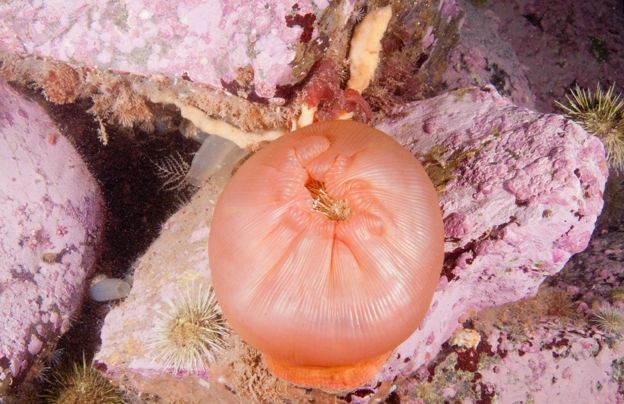
Anyway, I think scientists have also never stopped to search for new knowledge for new cure, and recently, I have read the interesting news which is “The creature with the key toimmortality?” (2015), prof. Dan Rokhsar
, professor of genetics at the University of California, and his team study a gene or pathway in sea anemones to search for the way that allows us to avoid ageing.

Dan Rokhsar says “As far as we know, these are immortal animals,"

 "They live a very long time - one was documented to have lived 100 years. They don't have old age. They live forever and proliferate, just getting bigger."

Actually, although he has found a lot of similarity between sea anemone and human, there is a difference between sea anemones and humans that worry him because people also have thoughts, memories and consciousness that the anemones do not have, so studying in the sea anemone may not help to retain these bright and present in new regenerating bodies.

However, I also think that someday when new innovations in medical technology have much developed, it may be possible that we might find the way that humans can live much longer than nowadays (the average life expectancy of worldwide might be around 300-500 years old),or we might become immortal.
_______________________________________ 


My question is:
Would you like to be immortal?  Why? Why not?
___________
Reference


The creature with the key to immortality?. (2015, October 9). BBC News. Retreived from http://www.bbc.com/news/magazine-34454844

Wednesday, 14 October 2015

San, Sami and pre 1700s American Indians, or 21st century US and China: which societies are more violent?

Reading Na's blog post again, I thought of a connection with the societies we have recently read about in the readings in chapter of Quest: the pre-European tribal cultures of North America, the Sami reindeer herders, the farmers of the US Midwest, modern Japan, the San hunter gatherer people, the US and China (Hartmann, 2007).

Hartmann focusses on the economic similarities and differences among the groups she discusses in her readings, but a question that occurred to me was what the differences are in peacefulness and safety from violence among the different types of society. For example, looking at my own country, which are the more violent cultures: the traditional tribal cultures of the native Australians who were there for 40,000 years before my ancestors took over, or the modern Western culture of Australia? Is modern, Westernising Thailand more or less violent than the more traditional versions of Thai culture? Also worth considering I thought is whether the world as a whole is becoming more or less violent and dangerous.

The 9/11 terrorist act that we discussed briefly in class this morning also came to mind, and apart from Na's response to the recent terrorist bombing in Turkey, the recent bombing at the Erawan shrine likely also comes to mind.
_______________________________________ 

My question is:
Which type of society is more peaceful and free of violence: more traditional societies or modern states?

___________
Reference
Hartmann, P. (2007). Quest 2 Reading and Writing (2nd ed.). New York: McGraw-Hill.

Tuesday, 13 October 2015

Now technology can make life easier than before. We can make it cheaper, distribute it, copy it as much as we want and don’t need  more cost. For example, we can send the photos in the party or graduation ceremony to everyone you wants and as much as you want via social network. The utopia of Marxism thought may occur in our generation now that we can have a machine that produce at the amount as you want without more cost. this is main topic of the book the end of capitalism and sharing economy will grow in both amount and territory.

Technology also make the power to create the things distributed to common people. Last week Adobe has announced the pilot project of application from iPad that can customized your own typography, so you can have your own font type without that much knowledge about graphic design as you can see demo here.


I think this is a phenomenal innovation which deliberate the creativity power to the people and push the technician to be more productive than adjust the width and height.

So, the question come to my mind that someday not too far we all may be laid off from the job that the robot or technology can finish with the lower cost as the writer said in the article. for example, the pharmacists may be gone from the pharmacies and some technology will replace and lead to safer and cheaper service for the customer. Do you think the robot can replace the human for any kind of jobs?
_______________________________________ 

My question is:
Do you think your job or the field you have graduated from can be replaced by the robot or advance technology?
___________
Reference
Mason, P. The end of capitalism has begun. (2015, July 17). The Guardian. Retrieved October 13, 2015 from http://www.theguardian.com/books/2015/jul/17/postcapitalism-end-of-capitalism-begun

How easy is killing a person?

When it comes to war, both sides have signed an invincible contract to death. It goes without saying that the possibility of death is very high. It's a kind of a mutual consensus. With both sides holding a weapon against each other, they are in a somewhat equal footing. However, when one side is defenceless, what could condone the one holding a weapon against them? The Ankara attacks is such a huge blow to humanity. When one is calling for peace by using peaceful mean, no matter how
much disagreement the other side holds, it shouldn't end this way. And it makes us wonder what kind of people the bombers are to be able to plan this heartless action. Are they now celebrating their victory over blood, tears, and lives of the loss? What kind of belief are they holding for such a conduct? And it makes me wonder if it's that easy to take away lives. An innocent life of people we do not know.
_______________________________________ 

My question is: Do you think you can kill a stranger on a street without remorse?

___________
Reference
Ankara attacks: Turkey in mourning after blasts kill almost 100. (10 October, 2015). BBC NEWS. Retrieved from: http://www.bbc.com/news/world-europe-34498497 

Monday, 12 October 2015

What are your (provisional) new year’s resolutions for 2016?

Referring to my previous article published last week (Monday, 3 October 2015), I presented the news from BBC News website about 10,000 steps a day to keep fit. It can be noted that this news is concerned with the number used for the sake of business—marketing strategies. Similarly, prior to this blog post, Punn (2015) has written the interesting article "Do you believe in lucky numbers?" The article is again related to the numbers and their influences on our lives. Someone may agree with luck causing by the number; however, it would depend on individual belief and attitude. More importantly, it would be undeniable that many numbers has become part of daily life in different aspects such as phone numbers, ATM password, lottery and stuff like that. Whether the lucky numbers exist is still intriguing question as well. Yet, certainly, there are magic numbers created deliberately, especially in terms of business, psychology and the like. Some examples of magic numbers could be found in my comments given to Punn’s post about lucky numbers.

Here I would like to illustrate another example of a magic number that is attributed to a theory regarding achieving goals. In "Can 10.000 hours of practice make you an expert?", Ben Carter (2014) mentions that 10,000-hours concept first emerged in The Role of Deliberate Practice in the Acquisition of Expert Performance, a 1993 paper which was about the study of practice habits of playing violin by Prof. Anders Ericsson from the university of Colrado and his group. Prof. Ericsson summarized that "many characteristics once believed to reflect innate talent are actually the result of intense practice extended for a minimum of 10 years". Then, Malcolm Gladwell, the author of Outliers: The Story of Success, proposed the 10,000-hour rule by referring to such a magic number related to the work studied by Prof. Ericsson. Yet, in fact, prof. Ericsson says that 10000 hours are just an average time, and this concept depends on the quality and the clear goal of practice as well, whilst Gladwell believe that talent doesn’t matter or even exist and doesn’t mention the true concept of deliberate practice of Prof. Ericson. He has interpreted the Prof. Ericson’s work differently. So far, his 10,000-hour rule has raised a question whether it is true that you can an expert in anything or any skills without any talents by just practicing 10,000 hours.

In fact, last AEP term, I (2015) wrote the article "Talent or Pratice?" which presented another interesting aspect of the importance of practicing against having talent in the different manner when compared this post as well.

Even though, some people disagree with Gladwell’s rule and has also proven that someone spend time less than 10,000 hours in practice to be good at something (goals). Therefore, the success relies on talent, right practice, intention; something takes long time, but others might not. I, myself, view that although there is no guarantee about his rule, setting the time for practicing like that (10,000 hours) could be useful to help us have a clear plan and a goal in achieving anything for a long time without giving up in the short time. Noticeably, the similar magic numbers are used commonly for promoting business with respect to learning anything or education, for example, master in English within 3 days, guitar professional in 30 hours. This kind of number seems to be magic to make people feel good when learning; nevertheless, it doesn’t mean that to do so under specific time is always effective and successful.

By the way, the above story makes me realize that most people are likely to often set their goals to achieve for a better life in different aspects regardless of whether they have talent or not. I am also a person who tends to do like that as others do. In particular, when starting a new year, I usually have new resolutions for my life every year. Until now, year 2016 will begin in the next few months. I suppose that many people including me are setting and planning their goal as New Year’s resolutions. The point I’m interested is whether you have the (provisional) resolutions for 2016 or not and what they are.

_______________________________________ 

My question is:
In the upcoming New Year, what are your (provisional) news’ year resolutions (goals)?

___________
Reference
Carter, B. Can 10,000 hours of practice make you an expert? (2014, March 1). BBC News. Retrieved from http://www.bbc.com/news/magazine-26384712

Ingpochai, P. Do you believe in lucky numbers? (2015, October 9). Class Blog - AEP at AUA. Retrieved October 11, 2015 from http://peteraep.blogspot.com/2015/10/do-you-believe-in-lucky-numbers.html

Sueviriyapan, N. Talent or Practice? (2015, August 17). Class Blog - AEP at AUA. Retrieved October 11, 2015 from http://peteraep.blogspot.com/2015/08/talent-or-practice.html

Friday, 9 October 2015

Do you believe in lucky numbers?

When we talk about numbers, I am definitely certain that all of you guys might have at least a number as the favorite one for something, and the most numbers, which we hold as the lucky one, must be in positive definitions itself.


Recently, there is an American sixth-grader girl - named Juliette Haming who was curious why the girls cannot play the football same as the boys. Then, she wanted to learn that and began practicing. In "Football-Playing Girl Wears No. 13 Because Taylor Swift", Juliet Spies-Gans (2015) says that Haming realized that she would like to play football and proudly wore NO.13 on her back because it is the favorite and luckiest number of her idol - Taylor Swift. Her beloved pop star could show that she can reach to the top, so Haming feel like No.13 can take her to be there as well.

As we all generally know that Number 13 is the unluckiest number, but if we ask how did it become unfavorable? What was the story of No.13? The answer seemed like I have listened such stories before, but I cant remember right now. So what's the matter if we can ignore about it. 

I just comprehend something in my mind which bold me for a long time since I was a child, and now it doesn't matter for at all. Indeed, one thing is the No.13 belief. If we combine one faith called the rules of mirror, which everything you think, believe, or wish in your mind can become true in action, with the case of negative thinking, and then we can change it into a positive way. It's merely such a little thing upon opinion. 

To do so, I change my own beliefs about numbers. All numbers are good for me and I've already set the positive meanings of each number. You can say that it's like a technique to be more confident. No matter any number you gen at anytime, it's all good for you.  


_______________________________________ 

My question is:
Have you ever had a lucky number?

___________
Reference
Spies-Gans, J. (2015, October 7). Football-Playing Girl Wears No. 13 Because Taylor Swift. Huffington Post. Retrieved from http://www.huffingtonpost.com/entry/football-girl-13-taylor-swift_56153284e4b021e856d2f815

Thursday, 8 October 2015

Would you be treated by a medicine with side effects?

When I was young, I had suffered from asthma.
I cannot sleep or play as other healthy children.
I always went to a hospital and took amounts of medicine.
I had to inhale a medicine which made me breathe easier.
At this time, I still remember its smell and yes, I like it!
However, if I knew, I would deny.

Cr. livescience.com
In year 1994, when I was about three years old (or younger than that), I used to sick from fever and asthma. Although it was not too bad as other severe disease, I was not a healthy child. A hospital was my second home while other kids went to their school. My father told me that a doctor had to give me strong dose medicine to treat. I was admitted in the hospital several times, once the longest period was over a week that I missed the final examination – Luckily, I was in a kindergarten. Sometimes when I was not admitted, I still was taken to the hospital for an inhale medicine because I couldn’t breathe. It was my most favorite medicine as my mother thought it was oxygen, but after I read the followed news, I realize something.

According to “Asthma steroids 'could stunt growth'”, there is a correlation between ICS (inhaled corticosteroids), an asthma medicine, and height growth stunning of children, presented in the European Society for Paediatric Endocrinology (ESPE) congress; hence, the kid patients should be followed up their height and weight each year. The ICS has side effect to some people not except adults, which is about three centimeters decrease in height. (2015)

Height affects to people’s life especially in chance of getting careers. A lot of careers require at least 160 cm for women and 170 cm for guys such as a cabin crew, or taller than that as a model. It is also correlated with power of communication that a person who is taller looks more charm and majestic. Not only for social status but also in daily life, a people, who are tall, take more opportunity to do everything by their own. They can pick a book from height shelf, look strong enough to take care themselves and also in a crowd place such as on a busy time in sky train or in a fair, they can find air for breathe!

The causes of personal height depend on genetic and factors: nutrition, inhibition, habit. The inhale medicine is not only one can stop children’s growth. A chemical which is used in meat especially chicken is also an important cause, which leads many girls get mature faster in ill-time; moreover, more dangerous, it is a carcinogen - a chemical which stimulate cancer.

Cancer is a main cause of illness death around the world. Unlucky it doesn't have the exactly way to be cured. Two of my relatives, one of my acquaintances passed away because of it, as well one of friends still endure to it with her age, only 24 years old. She has choices of the treatment, but some of the them lead strong side effect. It is a risk which the patients who get the medical treatment, may either be cured or more suffer; hence, they will have less time to spend on the world with their friends and family.

_______________________________________ 

My question is:
If you were a patient who was suffer from a severe illness (or whose relatives), would you receive a treatment which has long term side effects?

___________
Reference
Asthma steroids 'could stunt growth'. (2015, October 3). BBC News. Retrieved from http://www.bbc.com/news/health-34427956

Wednesday, 7 October 2015

Should we intervene in nature to help animals?

It is commonly believed that we have an obligation to help those who are in need. It is true that we cannot help everyone, but we should not stop from helping other people whenever it is in our power to do something about it.

Last week, I watched a documentary about wildlife on TV. The story was about predators and preys which showcased various predators and the way they captured and killed their victims. What I have seen is that lionesses attacked a baby giraffe, a baby Penguin was killed by an Antarctica Skua and the other frightened scenes. While I was watching this program, I just raised the question is that why the cameramen didn’t do anything? What I mean is why they didn’t try to save those animals.

Actually, I understand that every living thing on this planet depends on the complexity and wonderful subtlety of ecological systems. We can understand them by only observation, not by trying to change or control the elements of the system. In other words, we might not have a reason to alleviate or prevent the harms of wildlife.
The dolphin was trapped in Sharpness Port for 24 hours

According to “Trapped dolphin rescued from Sharpness Port” (2015), the dolphin followed container ships and trapped into the low tide. Fortunately, it was rescued by lifeboat crews, who were used to guide the animal out of the port. They guided the dolphin out of the shipping complex and send him back to where it came.
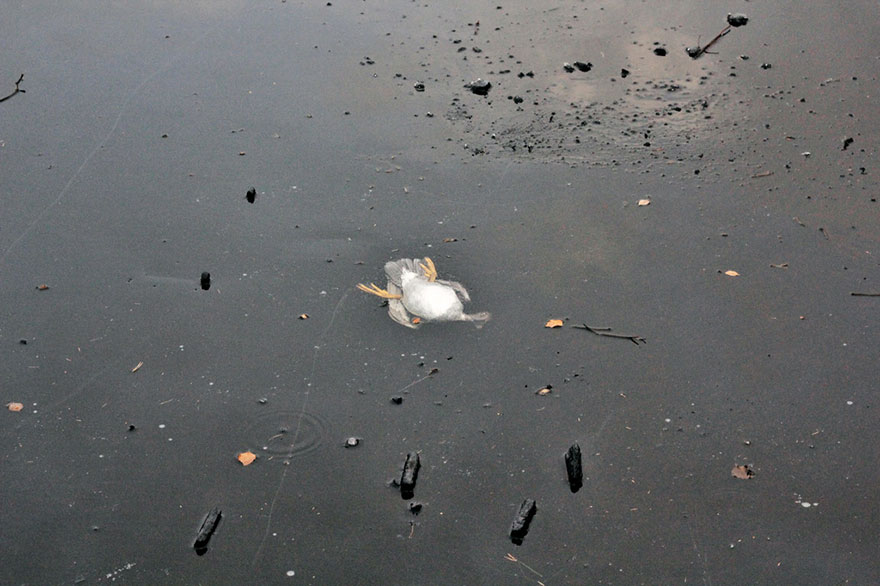
The poor duck got trapped under the ice.

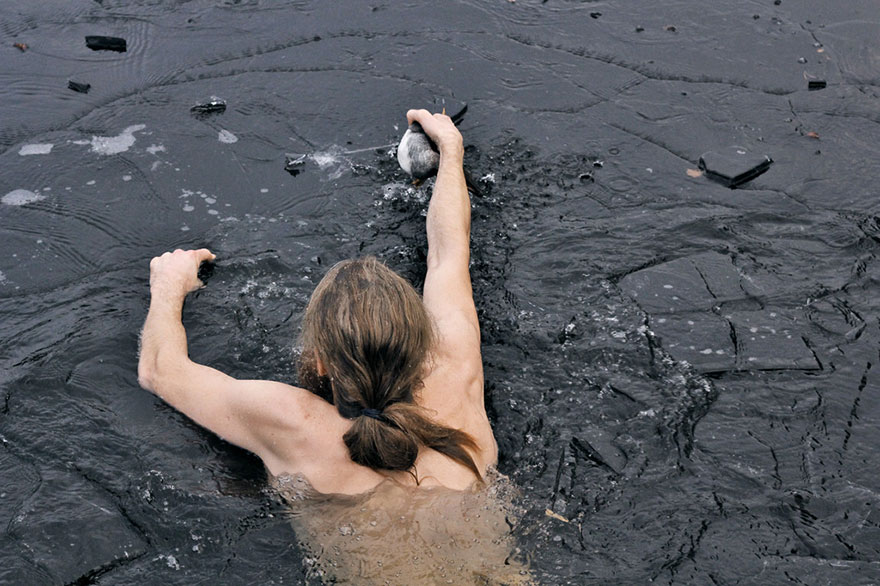
And when I was surfing the internet, I also found this interesting news that I think I can be another example for my blog post “Norwegian Guy Plunges into Frozen Lake toRescue Drowning Duck”( Dovas, 2014), Lars Jørun Langøien jumped into the frigid lake to rescue a duck trapped under the ice on the surface of a lake.


Lars jumped into the freezing water
Well, helping the animals like this seem praiseworthy. However, I also think what the lifeboats and Norwegian guy have done is whether they have intervened nature or not. Some of them are going to get hurt and others are going to get lucky, and maybe you have no right to change it.In other words, the best way that we might do for those animals is to let them be.

________________________________ 

My question is:

Should we intervene in nature to help animals?

If you saw an animal which are in danger as my example news (the dolphin and duck), or being attacked by other animals, would you help them or just let them be?
___________
Reference
Trapped dolphin rescued from Sharpness Port. (2015, October 2). BBC News. Retreived from http://www.bbc.com/news/uk-england-gloucestershire-34426608

Dovas, (December 15, 2014). Norwegian Guy Plunges into Frozen Lake to Rescue Drowning Duck. Boredpanda. Retreived from 

Is it right to bomb a hospital even if your enemy is in there?


There is a hospital bomb report in Afghanistan. And it raised 1 question to me. Is it right to destroy a hospital if your enemy is undergoing a treatment in there? I wonder what kind of moral these bombers are following. What kind of moral would justify the destruction of what is viewed as a sanctuary of many? Generally speaking, inside a hospital there are patients and staffs who should not be touched since one is people who could not help themselves while another is people who are conducting a good deed by helping the prior. So it is a commonsense to not harm this kind of place. Speaking of a normal value, this kind of conduct is morally wrong. And even if we do not talk about a moral and instead thinking of a sense of pride of a warrior of old, it’s still an action below their pride since these people are not capable of self-defense. Therefore, it makes one wonders if these people are still human.     


_______________________________________ 

My question is:
Would you bomb a hospital if your enemy is in there?

___________
Reference
Afghan hospital attack: MSF condemns air strikes in Kunduz. (2 October,2015). BBC News. Retrieved from http://www.bbc.com/news/world-asia-34433302

Do you check your beliefs about facts? (A most unusual image for the NYT)

I'll write a proper title and post later, I just wanted to post the image. I don't think I've ever seen the normally restrained New York Times do this before. It certainly caught my eye when the page opened. It's probably just as well the looping stops after a few seconds.
_______________________________________ 

Let's start with a question: which is healthier, tea or coffee?
Question 2: how confident are you of your answer?

Had you asked me these questions just a few years ago, my answers would have been that tea, especially green tea, is healthier than coffee. In fact, I believed, as I think was a popular belief, that coffee was unhealthy in some ways, and that tea was generally good for health. And I would have been fairly confident. You might already have guessed that these confident beliefs were wrong.

I actually started seeing solid, well-designed research papers on the health effects of coffee a few years ago now, and I have admit, as daily coffee addict (and I do mean addict - I have a physical, if not psychological, dependence on the drug) I was very pleased to discover that as more research was done, coffee in moderate amounts, say 2 to 6 cups a day, was almost entirely good for health.

But until this morning, I had not realised how very weak were the common health claims made for tea, especially green tea. It turns out, according to a comprehensive analysis of meta-studies by Aaron E. Carroll in the New York Times article "Health Benefits of Tea? Here’s What the Evidence Says," that whilst the evidence does not support "strongly recommend[ing] that anyone take up tea," it might offer some health benefit and is unlikely to be harmful (2015b). This did surprise me, but Carroll gives links to reliable sources all the way through - mainly studies he cites - and he certainly seems to know what he's talking about. Carroll, a professor of pediatrics at Indiana University School of Medicine, conveniently gives a link to an earlier article he wrote, "More Consensus on Coffee’s Benefits Than You Might Think," in which he reviews the evidence for the health benefits of coffee (2015a). The evidence supported ideas about coffee did not surprise me, but I liked seeing them all in one place, again with links to the studies that support them.

Now I'm wondering why I ever believed that coffee was unhealthy and green tea was healthy with such confidence. I guess it was just that everyone around me accepted those beliefs, and advertising contributed its bit. More importantly, until a few years ago, when my very real addiction to coffee worried me enough to push me to do some research into the facts about coffee, I hadn't realised it was largely healthy. I drink at least two large cups of strong, fresh brewed black coffee every day, and have for almost forty years now. It was a very welcome surprise to find out that I'd been wrong about coffee, and that many people still were. But the surprise this morning on learning that the popular belief in the health benefits of green tea is not at all solidly supported by evidence was a lot more surprising. To balance things out a bit, I could also tell a story or two about the less pleasant consequences of actually being addicted to coffee, but perhaps in another post.

It was a great joy, and very refreshing, to have my third coffee today when I saw my visiting guests off around 7:00 PM.

Now, which are you going to opt for: tea or coffee?
_______________________________________ 

My question is:
Provisional question: What do you think the New York Times story I've chosen to respond to is about?
(If we can have provisional thesis statements, why not a provisional question?)

My real question is:
Do you check your beliefs about facts against solid evidence?

___________
References

Carroll, A. E. (2015a, May 11). More Consensus on Coffee’s Benefits Than You Might Think. The New York Times. Retrieved from http://www.nytimes.com/2015/05/12/upshot/more-consensus-on-coffees-benefits-than-you-might-think.html

Carroll, A. E. (2015b, October 5). Health Benefits of Tea? Here’s What the Evidence Says. The New York Times. Retrieved from http://www.nytimes.com/2015/10/06/upshot/what-the-evidence-tells-us-about-tea.html

Tuesday, 6 October 2015

Reviewing the history

When I am surfing through a tons of headlines in the newspaper’s website, suddenly I have run into this headline about an examination of Pompeians’ plaster casts. As you know, The Pompeians died from the eruption of the volcanos, then they became casts that locked their dead bodies inside without changing any posture in the minute that they have passed away. Should we see them mysterious or scary? That is one of the most famous occurrences in the history of archaeology, still we have known very little about it.


Plaster casts of people who died in Pompeii, Italy, after the eruption of Mount Vesuvius in 79 A.D.
Credit: Gianni Cipriano for The New York Times
Now There is a new examinations of the casts thanks to our new technology, very common used in medical purpose to make a 3D model of the internal organ, called CT scan, so we can find new data about them.

Plaster casts at a field hospital in Pompeii, where an array of specialists 
used computerized tomography scanners late last month.
Credit: Gianni Cipriano for The New York Times
“We’re the antidote to an unscientific approach,” said Estelle Lazer, an Australian forensic anthropologist who has researched Pompeian bones for 30 years, publishing a study, “Resurrecting Pompeii,” in 2009.

The data has appealed many data in contrast to the previous belief explaining the casts.

For example, one cast, found in the Forum in 1963, has been known as the “pregnant woman” because of the protuberance of the belly. The CT scan revealed the person was probably not pregnant, and may not have been a woman.


I think that it is great to have a new tool to revise the previous explanation about history, so you can get the more accurate understanding our own becoming.
_______________________________________ 

My question is:
Which history event can interest you most or want a new information?

___________
Reference

Elisabetta Povoledo. (2015, October 5). Scientists Hope to Learn How Pompeians Lived, Before the Big Day. The New York Times. Retrieved from http://www.nytimes.com/2015/10/06/world/europe/scientists-hope-to-learn-how-pompeians-lived-before-the-big-day.html?_r=0

Monday, 5 October 2015

Quest 2, p. 24, x. H - your culture.

This is Hartmann's response writing exercise for chapter 1. It's exercise H on page 24 of Quest 2 (2007).
_______________________________________ 

Choose one of these topics: 
  • a popular product in your country that comes from another country. 
  • one custom that is important in your culture 
  • one value that is important in your culture 
Write about your topic for 7 minutes.
___________
Reference
Hartmann, P. (2007). Quest 2 Reading and Writing (2nd. ed.). Nnew York: McGraw-Hill.

How do we avoid being market victims?

With the advent of new technology and innovation, a great number of gadgets and creative products are incessantly manufactured. Likewise, many people in the modern society tend to approach to materialism; there is a continuous increase of new consumers who seem to become market victims like me. It would be undeniable that today’s products lead to both positive and negative effects on humans, creatures as well as environment, and the degree of effects relies on how suitably consumers uses. The vivid example is a smart phone or a tablet. To me, it is really helpful for my life in various aspects—education, entertainment, communication and the like; on the contrary, someone may use their phones too much to play games or chat with both old and new friends, and thus it possibly causes disadvantages their health and life. So, we should think carefully before buying anything and consume goods properly and usefully.

Indeed, sometimes I am likely to buy products, especially new gadgets, without any necessity—just for the reason that I like them and want to possess. Recently, I have bought a Fitbit surge watch, wearable device which can track one’s fitness levels, to wear instead of my old watches just because of my personal demand and interest in new technology, though the price this watch is almost as high as that of an AEP course. Perhaps, my desire has been aroused by the well-created strategic marketing of Fitbit company via many kinds of media.

According to “Do you really need to take 10,000 steps a day to keep fit?” (2015), many fitness-tracker companies including Fitbit promote a default goal of 10,000 steps a day in their products to increase sale volumes. The main functions of such devices superior to regular watches will help track calories burned, distance travelled, heart rates, sleep periods and so forth. Of those functions, the default goal of walking is set 10,000 steps a day, but this goal can be customized. It can be noted that the origin of this magic number is believed that it is the concept of 10,000 steps in the run-up to the 1964 Tokyo Olympics. However, since the users need to wear this tracker on their wrists, some experts view that the record of motion in users’ leg in such devices would not be enough accurate for the reason that some steps of 10,000 steps may include other motions of users such as bending hand. Actually, even though we do not have this kind of watch, we can still reach 10,000 steps a day by walking routinely around 5 miles a day.

Now, I have been wearing it since I bought. Yet, I am not sure if it is worth buying. Whether this is due to my passion in technology and innovation or just I am not a smart consumer who has become a market victim is a question that I should think. Obviously, there are a lot of ads, campaigns, events, free gifts, trial products, promotions, and sponsorship from companies to attract as many customers as possible. Apart from me, I believe most people would be convinced to buy anything despite no real necessity. Accordingly, it should consider and find out the ways that can help us to avoid strategic marketing and be smart consumers in order to save our money and reduce the consumption of useless products.
_______________________________________ 

My question is:
How could we be smart consumers?
___________
Reference
Do you really need to take 10,000 steps a day to keep fit? (2015, June 15). BBC News. Retrieved from http://www.bbc.com/news/magazine-33154510

Sunday, 4 October 2015

Would it be important to go to school or university?

“I don’t want to go to school” I used to hear this word from my neighbor’s son when a school bus picked him up every morning. Actually, I also felt the same as him when I was a little child “could I just stay and study at home?” this question had always come to my mind, and at that time the answer was always “never”

Around two decades ago, nobody had known about computer or internet, but these things nowadays have played a vital role in our society. Many people can connect to the internet at home, and use it for many reasons such as shopping online, watching movies online, communicating with other people and so on, and what’s about study online?

According to, “Exeter University and Pearson plan onlinepostgraduate degrees” (Burns J., 2015) is that The University of Exeter will start online masters' degrees in a variety of subjects around September next year. The university says that students can decide where and when to study, and it is possible for people who work full time to further their education. It also says the new courses will provide online students with the same entry standards as those who study in person.

Actually, this news doesn’t surprise me because we are living in the world that everything might be possible due to modern technology, and I have heard about study online before, but this just raises a question about the necessary of going to schools.

It is understandable that students need to go to school to get a good education for their future career, but I just think that if every university and school provided online programs for many students as the Exeter University will do, so it might be unnecessary for students to go to universities or schools. They could just sit in front of their computer and study via the internet, and also get a degree for their career as well.
_______________________________________ 

My question is:
Do you think going to school or university would be important if we could study via the internet?
___________
Reference
Burns, J. (2015, October 1). Exeter University and Pearson plan online postgraduate degrees. BBC News. Retreived from http://www.bbc.com/news/education-34412637


Do the murder deserve any human right?


And the tragedy in US happens again. The massacre by a gunman occurred in Oregon college. As always, the medias come to dig in the information about the suspected. The interviews from the family and his family background was announced without censoring name or face. But this time, the email has lead us further. The digital tracing lead us to the activities online such as blogging, crowd funding which is drag to the file shared by bit-torent also include archetypal pornography. Isn’t it fair enough to feed the overwhelmed mass with this kind of data which can be judged like finding a spot on the cloth. Maybe he could be interested in other file not the represented file. If it’s okay to be a judge or criminologist, by just watching the news. Isn’t it public interest or gozzip news. Now comes the question to my mind.
_______________________________________ 

My question is:
Is the relatives of the suspected or murder have the right to their own or even the murder’s privacy?

___________
Reference

Jacob, B. Woolf, N. (2015, October 1)Chris Harper Mercer: details emerge of Oregon college killer. The Guardian.Retrieved from http://www.theguardian.com/us-news/2015/oct/02/chris-harper-mercer-first-details-emerge-of-oregon-college-killer

Saturday, 3 October 2015

Travelling full time: can everybody really do this?

Are there people who could leave everything in their life to travel? By knowing nothing about the future, these people must be very courageous. Leaving everything to start a new life with uncertainty because it is our passion, is it a good enough reason? Then if your passion is not enough, then what would be? These thoughts circulate in my head as I read through Iovino’s article of “A one-way trip to Hong Kong that’s lasted 7 years.” She left everything at home to follow her passion: travelling. I thought what she did was very admirable. Then I looked at myself and thought what if one day my daughter came to me and said she would quit her job and go on explore the world as a full time traveler. What would I do? Then I would have to ask her whether she has enough money to do so. How long that money would last her? When she used up all the money, what would she do? Is it possible for everyone to follow Iovino’s step? Living off a blog that shared her experiences on travelling. How many people are actually successful in doing this? I thought about it then it raises another question. What if they failed? A few people makes it through doesn’t mean the others could do it as well. There is no guarantee that this advice will lead you to succession. So it comes to my question “travelling full time: can everybody really do this?” However, people should not give up on their dream and passion. So I guess it depends on your judgement. Could you really live with yourself if you do not follow your dream? And if you did, and it did not go according to plan, can you still live with yourself after that?

_______________________________________ 

My question is: Travelling full time: can everybody really do this?

___________
Reference
Iovino S.(2 October,2015) A  one-way trip to Hong Kong that's lasted 7 years. Retrieved from http://www.bbc.com/travel/story/20150827-how-i-quit-my-job-to-travel-the-graphic-designer

Is religion more good or more bad for human society?

Mr Akhlaq's old mother was beaten by
the crowd, there are deep wounds
on her eyes
Since we had been discussing both eating meat and its cultural aspects, when I saw the BBC News story "Indian man lynched over beef rumours" (2015) a few days ago, I was immediately interested. This article, which reports how a Hindu mob killed a man because he was rumoured to have killed a cow and eaten the beef!

But this morning there is a much more shocking follow up story in the BBC News. According to "Viewpoint: Why has India's 'beef' lynching sparked no remorse?" (2015), the Hindu people, inspired by their religious beliefs, do not think they did anything wrong in beating to death a man for the "crime" of killing and eating a cow! That would be like Australian's beating a person to death in Australia because they killed an ate a kangaroo, which is, with the emu, the main symbol on the coat of arms of Australia. However strongly the society might feel about kangaroos, however strongly Hindus might feel about cows, it is morally wrong to kill people for eating those animals.

Mr Akhlaq's family says a temple
made an announcement that
they had consumed beef 
But the killer Hindus in India argue, exactly as some people seem to have argued in this class, that if a society has a certain custom or value, then that is morally right for that society, which would mean the Hindu killers were in fact doing a morally good thing to beat the Moslem to death because he ate beef. This is another example that seems to me to show that there is something seriously wrong with thinking that moral good and bad are whatever a society thinks that they are.

However, my real interest here was different. It seems that religion often teaches and causes great evil. The Hindu example in these BBC News reports is one. I'm sure everyone knows of the bombings and other violent acts that people commit in the name of Islam. And Christianity has a very bloody history against people of other religions. Sadly, so does Buddhism, as the violence against the Rohingya in Burma shows. Maybe Jainism is truly a religion of peace and good morals, but if so, it seems an exception.

Of course, religion has also inspired great art: the great Buddhist art of Sukothai and Angkor are truly beautiful, although I suspect they may have been built by slaves (I'm not sure. Does anyone know?); similarly, much of Western art, architecture, along with music and literature, is inspired by the Christian religion; and Islam, too, has inspired great art and learning. And there are religiously inspired groups who feed the hungry, care for the sick and sometimes work for political progress, such as the abolitionists in the US who were largely Christian groups working to end slavery in that country, although the slave owners also had the teachings of the Holy Bible to support their immoral desire to continue the socially accepted custom of slavery. In the Bible, St. Paul very clearly says, "Teach slaves to be subject to their masters in everything, to try to please them, not to talk back to them" (NIV, Titus, 2:9). This is not loving. It is not morally right. It is what the Christian Bible teaches. (I should also add that many of the good American citizens who opposed slavery were atheists.)


Some good news to conclude: in case you visit Australia, it is perfectly safe to eat kangaroo, also emu. Both meats are regular items on menus, and I usually have some when I visit. The emu and kangaroo might both adorn our coat of arms, but that does not stop them being tasty meats for dinner, or lunch if you prefer. I like the steaks, but there are many other ways to enjoy this quintessentially Aussie taste delights.

I don't think anyone in Australia will beat you to death for eating our national symbols. I'm not sure about the legality of eating dog or elephant in Australia. I guess that elephant is off the menu because they are an endangered species. Dog is probably OK, provided it's killed painlessly and cleanly.
_______________________________________ 

My question is:
Has religion been more a force for moral good or for moral wrong in human society?

___________
Reference
Indian man lynched over beef rumours. (2015, September 30). BBC News. Retrieved from http://www.bbc.com/news/world-asia-india-34398433

Viewpoint: Why has India's 'beef' lynching sparked no remorse? (2015, October 3). BBC News. Retrieved from http://www.bbc.com/news/world-asia-india-34409639

Friday, 2 October 2015

What is your the most impressed experience to the world?

I love to travel.
I want to backpack.
I hope to explore new places.
I try to touch new feelings.
Hopefully, confidently, trustingly I can do.

Variety of the world, place and time.
Nature, tradition, culture and weather are ingredients that are balance mixed to be a unique place waiting for the discover of us.

The picture no. 17
- Terry Ward -
According to "50 Reasons to #LoveTheWorld", the page collects posts from both Instagram and Twitter users of their journey with pictures and comments, adding the hashtag "#LoveTheWorld". There are responses of wide range people including writer, photographer, chef and other to show their passion to our planet. (2015)

I believe that our world is really fascinate and charm with an enormous of concealed places. Everyone know that the origin of human is nature. Unfortunately, technology, which is developed by human, has negative feedback to our birth.
Do we enjoy the convenience life and forget the benefactor? 

Gallivanting reminds the reason why we love this small world.

Rayong province, Thailand
I want to travel to some places far away which are not full of technology, the places of nature or civilization. One of the fifty posts, the picture number 17 from Terry Ward, with his reason "Because I sailed aboard a small boat in Norway's Lysefjord and realised there's nothing grander than feeling tiny." inspire me to step out from the fear.


One day, the day that I have both time and money, I will explore the world by myself. I believe it will give me more than words can share, more than pictures can tell.  

_______________________________________ 

My question is:
Have you ever explored a place, which make you to be over the moon? Can you share your experience and your feeling?

___________
Reference
50 Reasons to #LoveTheWorld. (2015, March). BBC News. Retreived from http://www.bbc.com/travel/bespoke/story/20150309-50-reasons-to-love-the-world/index.html#return-to-the-beginning-2210

Is it good enough to use cloth bags instead of plastic bags?

The effect of global warming has aroused human to realize that our world and all lives are encountering with a serious problem about climate change. The main cause of such a problem results from human’s activities associated with the burning of fossil fuels to generate various kinds of energy, operate industrial processes and related activities. This causes such high amount of carbon oxides in the atmosphere that much more heat is stored in the Earth, leading to global warming and acute climate change.

And why does using plastic bags relate to global warming effect?

The answer is the more we use them, the more burning activities of the production and elimination of plastic bag occur. What’s more, after using plastic bags, they will become rubbish taking several hundred years to degrade naturally, thus causing many environmental problems. For example, each year there are a huge number of aquatic animals dying from eating plastic bags left in the sea or river, and meanwhile they cause water pollution as well. So, we normally prefer to get rid of them by burning rather than wait for natural decomposition. This means causes both air pollution from hydrocarbon compound released and global warming. With this reason, plastic bags have become one of the global warming trouble makers.

Not surprisingly, no-plastic-bags campaigns are currently popular activities in many parts of the world. According to “How can plastic bag addiction be cured?” (2015), Laws allowing the big department stores in which there are more 250 employees in England to be able to charge 5 pence per one plastic bags will come into effect on the next Monday (5 October 2015) in order to make shoppers use less plastic bags. In the meantime, many supermarkets also support reducing the use of plastic bags by offering promotions or extra points on clubcard to their customers if they reuse plastic bags or even use their own cloth bags. Nevertheless, Professor James Intilligator from Bangor University believes that such charge (only 5 pence per a bag) is too low to encourage them to avoid using plastic bags as punishment. In recent survey by Wrap—a recycling charity, there are 40% of shoppers who will use their bags although 39% think that this law will not successful to change the shoppers’ behavior.
By the way, in Thailand, now there is a new policy for this year to encourage people to decrease the use of plastic bag. The government will be in charge of this policy and incorporate with department stores, superstores, supermarkets, and minimarts by campaigning to reduce plastic bags in 15th of every month starting from August 2015. It also requires people to prepare their cloth bags or other types of bags not made from plastic to contain their stuff. The government expects that this policy will reduce life cycle of plastic bags from the production to elimination as well as one cause of global warming. Prior to this policy, there had been similar campaigns to give people free cloth bags; many companies and shops supported this idea by offering other people or customers free cloth bags which were produced by themselves as well. 

However, it is interesting that most people believe that the idea and policy about using cloth bags instead of plastic ones is a good solution without any doubts. In the contrary, I suspected that when producing cloth bags, it requires a lot of resources such as fiber from plants, water, chemical fertilizer, pesticide and the like, and its production can also emit carbon dioxides together with other waste gases and water. Therefore, whether such an idea is good enough or not seem to be a thought-provoking question as well.


_______________________________________ 

My question is:
Does using cloth bags help address the global warming problem?
___________
Reference
How can plastic bag addiction be cured?. (2015, October 1). BBC News. Retrieved from http://www.bbc.com/news/magazine-34401851

Do you think that everything can be possible in charge of tech development?

Once when I was a child, I was very desired and surprised with the picture in the first episode of Harry Potter - Harry Potter and the sorcerer's stone which be able to move lively, and I am certain that you are one of Harry Potter fans at that time as well.

Surprisingly, this animated picture in which was written by the imagination of J.K. Rowling is going to be real soon. Recently in "Your Facebook profile pic could soon be animated",  Andrea Peterson briefly says that we could soon be seen and use Facebook's profile pictures much more animated, because the product managers - Aigerim Shorman and Tony Hsieh in Facebook said that the company is starting to test profile videos.

Around 15 years ago, who believes that many things from human's thought and imagination will be developed actually? Not only the live photos in such case, housekeeper robots, a lot of visual games, and so on are also proved that they became true.

I have read the words from a book which I can't remember the title, there is someone who was telling me (the reader) that "if you want to create something new in the world, it is not in the books!" For instance, Steve Jobs did not build the empire of Apple from the textbooks, and Mark Zuckerburg  did not created Facebook from the study in University as well. They have passions to do something new in the world by their own beliefs.

I think that such above mention might not much relate to the question, but this news reminded me of that impressive sentence. Nonetheless, it can be also compared that there are nothing impossible so long as imagination can reach into, and yes the Facebook live profile picture as well. That's a good news, I love it!

My question is:
Do you think that everything can be possible in charge of tech development?

___________
Reference
Peterson, A. (2015, September 30). Your Facebook profile pic could soon be animated. the Washington Post. Retrieved from https://www.washingtonpost.com/news/the-switch/wp/2015/09/30/your-facebook-profile-pic-could-soon-be-animated/