Thursday, 17 November 2016

Design - Skillful Reading & Writing 3, p17

Skillful 3, page 17
Source background
On page 17 of our text, Bixby and Scanlon introduce the topic of design, which is also the title of Unit 2. As usual, they open with a large photograph and some discussion points.
_______________________________________ 

Discuss these questions in a comment below.
  • Look at the picture. Do you know where it is? What makes it special? What do you like or dislike about the way it is designed?
     
  • Think of three famous buildings or structures from around the world that you feel are well designed. What makes them interesting or beautiful?
     
  • Choose a famous building of structure from your country. What do you like about it's design? What do you dislike? 
You are not writing an essay or formal academic paragraph here, so although you should write your ideas down in sentences, don't spend ten minutes worrying about the whether your language is correct: just write! You have a total of ten (10) minutes.  

___________
Reference
Bixby, J. & Scanlon, J. (2013). Skillful Reading & Writing, Student's Book 3. London: Macmillan.

Do it immediately? Or procrastinate?

What I read 
In his paragraph "Life as I choose", Den writes that "There is a good thing being lazy." This suggested a point I thought worth brainstorming.
_______________________________________ 

Our responses
What do you think about procrastination? Students are often told not to procrastinate, but is this always the best course?
_______________________________________ 

Wednesday, 16 November 2016

Evolving theories among the mistakes

My, what sharp teeth you have
What I read 
According to "A new fossil find in Brazil rewrites the history of the dinosaurs", the recent discovery of dinosaur fossils dating back 230 million years in Brazil is forcing paleontologists to reconsider some of their theories about the evolution of dinosaurs, specifically, that they did not suddenly replace the earlier reptile species and whether they stopped eating meat then grew massive, or whether they started to grow massive which forced them to become vegetarians (2016).
_______________________________________ 

My response
When I was a child, I was fascinated by dinosaurs, and the bigger the better. The fearsomely carnivourour T. Rex never impressed me as much as the massive vegetarians like Diplodocus and Brachiosaurus, both of which I was pleased to see mentioned in The Economist's article. But to be fair, Tyrannosaurus Rex did add a lot to the Jurassic Park series of films, although I noticed that the last one thought that nature's efforts were not quite fearful enough, so the story added in a human boost to to the genes. Naturally, the mad scientists bring disaster by tampering with nature. But that is a lie.

Science has made our lives vastly better than those of any of our ancestors, who were largely forced to rely not on the healthy democratic ideals of science but the blind, blinkered and blinkering gloom and doom of religious belief protecting itself with ugly blasphemy laws, censorship, inquisitions, and other efforts against peaceful, honest truth seeking and speaking.

Of course, science is often wrong, which is a major point of this article in The Economist, but that's not a problem. It's a virtue. Science never pretends to have any perfectly infallible truths - that's the role of popes, imams, priests, sacred books and other tools of repressive political ideologies like communism and fascism, which seem to me much like any other state supported religion intent on protecting itself. I don't like being wrong, but I know I often am, recently about the electoral chances of Donald Trump, but about lots of other things, too. I agree with the paleontologists, those experts on ancient life on our planet, who, when the evidence is presented, admit that they were wrong and that they need to change their minds about some long held beliefs.

And this leads me to think about what truth is, or more importantly when and where we ever get it, or can get it. But that can wait for another blog post on another day. I still have work to prepare for tomorrow.
_______________________________________ 

Reference

It's 5 o’clock somewhere - let it be

What I read 
In "Time to Dump Time Zones", James Gleick argues that the enormous gains in consistency and simplicity would more than offset the initial confusion caused by abolishing time zones in favour of all of use using the standard time zone known as Coordinated Universal Time (UTC), which he would like to call "earth time" (2016).
__________________________________ 

My response
Although Gleick makes a good case for his idea, I'm not sure that I'm convinced. He is certainly right that it would be a jolt to make such a change. In fact, I think it would be more than a jolt: we would lose something useful. It isn't just that it would seem odd to me to be starting work at 2:30 AM (9:30 - 7 hours), and that I would be having lunch at 6:00 AM with the sun bright in the sky: it might be convenient knowing that it was exactly the same time in Australia, but that would not be very useful for deciding whether to call my brother or not. I would still need to know at what time he went to bed and so on. At the moment, he goes to bed around 10:00 PM, a bit earlier than I usually do in Thailand, but under Gleick's proposed change, I would be in the habit of going to bed around ... 5:00 PM, while Matthew would be in the habit of retiring around 11:00 AM ( = 10:00 PM - 11 hours). If I called him at the hour of 3:00 PM at night, very convenient for me, he would probaly be pretty annoyed, unless I had some seriously awful news to justify waking him at 1:00 PM.

On the other hand, Glieck does offer one bit of evidence that I found a bit more persuasive: apparently China uses only one time zone for its entire longitudinal breadth, which means that Chinese must be going about their daily lives at very different times of day, so maybe we could get used to a world with a single time zone.

Our next topic in Skillful is design, and I do like the design of the image that The New York Times editor put over Glieck's article. It captures neatly the the current and proposed systems. But again, I kind of prefer the messy left-hand side with its swirling lines, varied shapes and range of colours to the admittedly neat and simple, but also boringly black, white and regular, right-hand side. Simplicity and regularity are great, but a bit of messiness isn't always a bad thing.
_______________________________________ 

Reference

Shocking Triumph of Democracy

What I read 
In "What So Many People Don’t Get About the U.S. Working Class," Joan C. Williams draws on her personal experience of her husband's working-class background to explain the triumph of Donald Trump over Hillary Clinton. Williams' thesis is that its "the class culture gap" (2016). She argues that Trump's victory, against even his own party's professional leaders, reflects a deep feeling among the working class, not to be confused with the poor, that professionals such as doctors, lawyers and academics look down on them and their economic aspirations to be if not super-rich like their hero Trump, at least comfortably off through hard work. Williams says this resentment of people like Clinton and also the Republican leadership is what has driven Trump to the White House.
_______________________________________ 

My response
The way the Williams relates her personal experience to support the thesis she is arguing for reminds me of the writing exercise did in Skillful yesterday, where we related our personal experience to the ideas in the reading to support a main idea about ourselves, the idea stated in the topic sentence of the paragraph.

But I also like William's article in the Harvard Business Review because it seems to me one of the best explanations for what has happened in US politics over the past year. I had, like most of the professional class, including most of the media, been sure up to the time the results were announced that the American people would not elect Trump. How wrong we all were! How wrong I was! Naturally, I want to understand how I could have been so wrong.

Being wrong doesn't worry me too much. I've often been wrong about things in the past, and I'm certain (although of course I can't list any) that some of the beliefs I hold now are also false. Among the large set of things I believe, it would be incredible that all were actually true beliefs. Unfortunately, my beliefs don't come conveniently labelled as "true" or "false."

And now we have to live with Trump for four years. Unlike some of my shocked friends, and the mobs of street protesters, I think that Trump's election was entirely democratic. Just because he did not get the majority vote, which went to Clinton, does not make his election undemocratic, and having spoken, the voice of US citizens must be respected, however much we might not like it. The ugly street protests in various US cities, so very like the anti-democratic PDRC mobs that helped stamp Thailand's evolving democracy into the dirt under jackboots, are not a healthy democratic response to the election by the United States of Donald Trump.

I look forward with interest to the doubtless interesting times to come over the next four years.
_______________________________________ 

Reference

Killing them softly

Now cleared for recreation
What I read 
According to "US election: California voters approve marijuana for recreational use" (2016), a range of controversial proposition were approved by state voters "alongside the presidential election" that took place on Tuesday, November 8. These include not only the legalization of marijuana for fun by adults in California, but also a law change in Colorado so that its citizens can be given "medication that can be self-administered" to kill themselves if they are fatally sick. In contrast, the citizens of Nebraska approved a law change to restore their death penalty as legal punishment.
_______________________________________ 

My response
Whatever we might feel about the properly democratic election of Donald Trump as the next US president, I thought that these voter initiatives generally show healthy social and moral evolution. As the BBC's title suggests, they expect the rapid spread of the legalization of the popular drug marijuana to be the change that is most important, or at least the one that most of their readers are likely to think most important, or perhaps most radical. I think marijuana should have been legalized decades ago. In fact, I don't think that there was ever any good reason to make it illegal, and that such laws are contrary to good morals.  Since making less harmful drugs such as marijuana, yaa baa and cocaine illegal while leaving the more socially harmful drug of addiction alcohol legal is obviously irrational, that must also bring the law into contempt among rational youth who see the hypocrisy, the dishonesty, of those making up such laws.

But I think the drug battle is becoming old news. How many people still hold the false belief that the sale and use of some popular drugs, but not others, should be criminalized to the harm of all? Well, there are two groups in society who benefit greatly from such laws: mafia scum and the corrupt state officials who work with the mafia to make massive profits by supplying the products that a lot of decent citizens demand.

I thought the move to allow people to kill themselves was more interesting. Again, it seems clear to me that a right to life must also include a right to end your own life. The small progress towards this in the state of Nebraska is again a healthy move in the right direction. Other nations, especially the Netherlands, have gone further in respecting their citizens decisions to die, but these radical changes are probably best done in small, incremental steps. A proposition to allow citizens to direct doctors to kill them on demand would be so radical that it's hard to imagine more than a very small number of votes in its favour. In fact, such a radical proposal would not get enough support to even get on the ballot of voting. As the gradual changes in US drug laws shows, slow and steady change is the pragmatic way to go.

Slow and steady has also worked well for the gay and lesbian community, with the US Supreme Court last year ruling to make same-sex marriage legal in every US state. That is an amazing change towards justice from the ugly situation that existed when I was in school.
_______________________________________ 

Reference

Tuesday, 15 November 2016

Critical thinking - identity 1 - Skillful Reading & Writing 3, p9

Skillful, p. 9
Source background
Following the reading "Discuss It Online," there are a couple of questions to practice critical thinking, which, like most brainstorm or group type activities, are most usefully done online. We will do them here on our class blog.
_______________________________________ 

Discuss these questions in a comment below.
  • If you had to write a response to Dr. Green's discussion board question, which part of your identity would you write about? Why? 
  • Why is family an important part of a person's identity? 

You are not writing an essay here, so although you should write your ideas down in sentences, don't spend ten minutes worrying about the whether your language is correct: just write! You have ten (10) minutes.
___________
Reference
Bixby, J. & Scanlon, J. (2013). Skillful Reading & Writing, Student's Book 3. London: Macmillan.

Monday, 14 November 2016

Our criminal identities

What I found
In his book Predictably Irrational, economist Dan Ariely applies the tools of economics to human behaviour, which often appears irrational. As Ariely shows in these essays, based on his research and subsequent research papers published in journals, much of our seeming irrational behaviour is at least predictably so.
_______________________________________ 

Questions to respond to
Review the summary of our responses to the survey on the costs of crime in the US.
Respond to the following questions in a comment.

What we think for Thailand
  • How much agreement is there in our guesses? What is your explanation of this? 
  • Of the various types of activity on the survey, which do you think that the law should punish most severely? Why? 
  • And which should be punished the least severely? Why?
     
  • Finally, brainstorm examples of similar crimes. Your examples might be more specific, such as Ariely's example of retail clothing fraud. 
    • How serious do you think these crimes are? 
    • What should the punishment for criminals who commit such crimes be? 
    • How common are these crimes? 
    • How socially accepted is such crime in your culture? 
_______________________________________ 
Reference
Ariely, D. (2009). The context of our character, part I: Why we are dishonest, and what we can do about it. In Predictably Irrational: The Hidden Forces That Shape Our Decisions [2nd. ed., Kindle Edition] (pp. 271 - 294). HarperCollins.

What do you read for pleasure?

What I found in the news
In Writing In The 21st Century, Harvard academic Steven Pinker, emphasizes that:
The first step to being a good writer is to be a good reader: to read a lot, and to savor and reverse-engineer good prose wherever you find it. That is, to read a passage of writing and think to yourself, … "How did the writer achieve that effect? What was their trick?" And to read a good sentence with a consciousness of what makes it so much fun to glide through. (Pinker & Brockman, 2014) 
In this piece of work, Pinker also makes other points about how to write well, but the importance of reading a lot if you want to write well in any language is his major point, to which he adds the importance of enjoying what you read even as you read it critically.
_______________________________________ 

My response
I was initially going to do this response writing assignment to get us thinking about what we are doing in this class as a very short Classroom question, but when I tried to write my own very brief answer, I decided that was an impossible limitation, that it would be much better to invite you blog on the question for a few minutes. So, the questions to respond to are:
  • What do you read for pleasure? What do you read because you want to read it? 
    • Is that in English or your native language? 
  • Do you agree with Pinker? 
    • If you agree with this famous cognitive psychologist with a strong interest in how language works in the brain, what does that suggest we should do in our class? 
    • If you disagree with him, why do you think he might be wrong? It is healthy and normal academic practice to disagree with the ideas of others, but we are expected to give reasons for disagreeing. 
Your turn. In a new comment, respond to the above questions. 

_______________________________________ 
Reference
Pinker, S. (Speaker) & Brockman, J. (Introduction). (2014, September 6). Writing In The 21st Century: A Conversation With Steven Pinker. Edge. Retrieved from https://www.edge.org/conversation/steven_pinker-writing-in-the-21st-century
The Edge article is actually a transcript of a presentation by Pinker, and the video version is also on the page cited if you would prefer to watch and listen.

Tuesday, 8 November 2016

Identity (b) - Skillful Reading & Writing 3, p7

Image copied from Digibook
Source background
Following Bixby and Scanlon's question 1, we are ready to move on to questions 2 and 3, which give us another opportunity to introduce ourselves.
_______________________________________ 

Discuss this question in a comment below.
  1. What are some of the social groups you belong to?   
  2. In what ways are they important to you? 
You are not writing an essay here, so although you should write your ideas down in sentences, don't spend ten minutes worrying about the whether your language is correct: just write! You have a total of eight (8) minutes.  

___________
Reference
Bixby, J. & Scanlon, J. (2013). Skillful Reading & Writing, Student's Book 3. London: Macmillan.

Monday, 7 November 2016

Identity (a) - Skillful Reading & Writing 3, p7

Image copied from Digibook
Source background
On page 7 of our text, Bixby and Scanlon introduce the topic of identity, which is also the title of Unit 1. They open with a large photograph and some discussion points. We will do that discussion here on our class blog. Clicking the image on the right will show it full size. It's a copy I made from the Digibook version of Skillful Reading & Writing 3. It is almost identical to page 7 in the print version, the single difference being ...
_______________________________________ 

Discuss this question in a comment below.
  1. What are five words you would use to answer the question "Who are you?" 
You are not writing an essay here, so although you should write your ideas down in sentences, don't spend ten minutes worrying about the whether your language is correct: just write! You have a total of eight (8) minutes.  

___________
Reference
Bixby, J. & Scanlon, J. (2013). Skillful Reading & Writing, Student's Book 3. London: Macmillan.

Welcome to AEP Reading and Writing 2, term 7, 2016

Welcome to our Reading and Writing level 2 (AB) class for the term.
We are aiming at units 1 - 5


Over the next six weeks, we will be working through a few units in Skillful Reading & Writing 3 by Jennifer Bixby and Jaimie Scanlon, which involve reading and writing several different kinds of texts (2013). We will also add some extra reading and writing to keep things interesting every day; we will, for example, be regularly writing on this class blog and reading a text from outside of Skillful Reading & Writing.

I hope you find the class useful and also enjoyable.

In the meantime, you might like to have a look at the some of the posts on this blog by my students in previous classes.

Peter.
___________
Reference
Bixby, J. & Scanlon, J. (2013). Skillful Reading & Writing, Student's Book 3. London: Macmillan.

Thursday, 20 October 2016

Tesla's Fully Autonomous Car On the Public Road

What I found in the news

According to The Guardian article  "Tesla releases video of fully autonomous Model X electric car",  Tesla released video of  fully autonomous vehicles and announced that Tesla's car will be built with components required to turn to be a fully autonomous car. The following is the video showed self-driving car driving on the public road without man-control; However a person is required to be on the driving seat due to the US regulation.

_______________________________________ 

My response

This is first time that I see a fully autonomous self driving. This is very impressive. I imagine that it would be better if there is a self-driver Taxi; Many times, I've had to wait a taxi for a long time, especially when it's raining. However, I think it might be a long time until the self-driving cars can be such commercial uses. I don't know how far it is, but I hope that I can be in the car someday.

_______________________________________ 
Reference

Tesla releases video of fully autonomous Model X electric car. (2016, October 20). The Guardian. Retrieved from https://www.theguardian.com/technology/2016/oct/20/tesla-releases-video-of-fully-autonomous-model-x-electric-car

Water - Skillful Reading and Speaking, Unit 9

Source background
On page 87 of Skillful Reading and Writing, the topic of water is introduced in a unit with the same title. As usual, Roger and Wilkins open with a large photograph and some discussion points (2013). We will do that discussion here on our class blog. Clicking the image on the right will show it full size.
_______________________________________ 

Discuss these questions in a comment below.
There are also some useful language suggestions included in the image. You might like to use some of those expressions in your comments.
  1. Where does your drinking water come from? Do you drink tap water or buy bottled water? Why? 
    • I usually drink ... because ...  
    • It come from ...
       
  2. Water covers more than 70% of the Earth's surface, yet many parts of the world don't have enough drinking water. Why is this? How many different reasons might be factors here? 
    • Most of the water is ... 
    • There isn't enough water in ... because ...
       
  3. Which of the following water-related problems do you think is the most serious? Why?
    1. drought 
    2. flooding 
    3. water pollution
Your writing might be more fluent if you do not interrupt it by adding numbers. It is not important in what order you address the questions, or even whether you cover all of them. Their purpose is to serve as prompts to start you thinking. 

___________
Reference
Rogers, L. & Wilkin, J. (2013). Skillful Reading & Writing, Student's Book 2. London: Macmillan.

Art and history

What I found in the news
According to The Guardian article "Last art history A-level axed after Michael Gove cull of 'soft' subjects", one of the biggest exam board in UK called AQA will remove art history out of their A-level subject (2016). Looking statistic, there were only 839 students took the exam this summer. The AQA spokeswomen said that removing this subject doesn't mean this subject is not importance but the subject itself is too hard, which will create risk for students.
_______________________________________ 

My response
From yesterday conversation and Aon's academic interest about history, I think that history in general is very importance in our life. I would blame the way of teaching history in school that makes children hate or forgot this wonderful and useful subject. Same as Animal Farm, it shows how the world is going on at that time and also what people thing about political system in that specific country and also there are historic importance of Russia revolution that would creates a ripple effect that leads ultimately to cold war and Cuba missile crisis, which smallest mistakes could turn the whole planet to stone age. Without Vasili Arkhipov, the captain of thermonuclear submarine, we won't live like what we live right now because he is the one who vote "no" to launching nuclear warhead. As you can see, with only one person, can change the fate of the world completely and how fragile our political systems are.

Coming back to art. Last term, I had a chance to study pop art. Art is just like history book where it records major changes in human history. Not just the events but also what cpecific artist mind is.
_______________________________________ 
Reference
Last art history A-level axed after Michael Gove cull of 'soft' subjects (2016, October 12). The Guardian. Retrieved from https://www.theguardian.com/education/2016/oct/12/last-art-history-a-level-axed-after-michael-gove-cull-of-soft-subjects?INTCMP=sfl 

Tuesday, 18 October 2016

The German Napoleon

What I found in the news


According to the BBC News article "Hitler birthplace: Austrian minister retreats on demolition",  Wolfgang Sobotka, Austria's Interior Minister, has changed his mind about destroying Hitler's guest house by renovate it instead(2016). The committee of experts said "demolishing the house come close to a denial of the Nazi history in Austria", so they suggested that the house should be renovated in order to reduce a symbolic power and used it for social purpose.

My response
After we talked on "Animal Farm" and mentioned about Hitler I decided to choose this article for bloging because I would like to know the story of him and some people may not know much about it, so I would like to tell his story briefly.
   According to"Adolf Hitler Biography", Adolf Hitler was born in Austria in 1889 before he became leader of the National Socialist German Workers Party or Nazi party, he has been a painter who was interested in German nationalism. During the World War I, he served in German army and also won several awards for bravery. Unfortunately, Germany lost WWI and Hitler was shocked by German's surrender, he though that the German army was defeated because of civilian leaders and Marxists. After WWI, Hitler still worked for military he joined German Workers’ Party (DAP) as a spy for the Army. When he was in DAP he received many ideas of the anti-Semitic, nationalist and anti-Marxist ideas. In 1971, he became leader of DAP and changed the name of the party into Nazi. Moreover, Hitler was a starter of World War II by invading Poland in  1939. Finally, as we know, Germany could not win the war and Hitler decided to end his life by committed suicide on 30 April 1945.
_______________________________________ 
Reference
Hitler birthplace: Austrian minister retreats on demolition (2016 October 18) BBC News. Retrieved from http://www.bbc.com/news/world-europe-37690981

Adolf Hitler Biography (2016 October 6). Retrieved from http://www.biography.com/people/adolf-hitler-9340144

Monday, 17 October 2016

Father of the Thai Nation

What I found in the news

According to the BBC News article "Thai king death: Thousands queue to pay respects at palace" (2016). King Bhumibol Adulyadej was the world's longest-serving head of state. At the Grand Palace, in the Thai capital, Thousands of people queued up to sign a book of condolences and dressed in black to pay respect to King Bhumibol Adulyadej, who died on Thursday. Also, free buses provided for people from rural areas. On Friday, the King's body was transported in a convoy to the Temple of the Emerald Buddha in the Grand Palace from the hospital where he passed away. Former Prime Minister, Prem Tinsulanonda, would be regent because Prince Vajiralongkorn has asked for a delay while he grieves for his father. During this period, people have been asked to wear black and avoid "joyful events". For the next 30 days, flags are to fly at half-mast and official mourning will last a year.

_______________________________________ 

My response
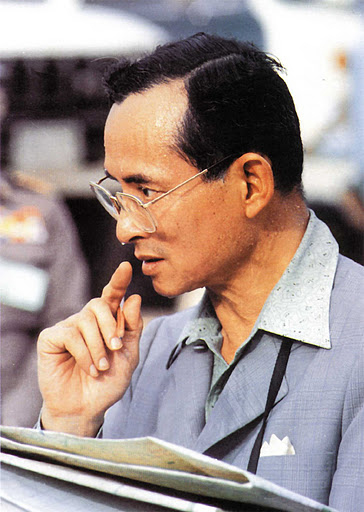
Image result for ในหลวงAlthough I was born in 1997 which is already about 50 years of the  King's accession to the throne. So I didn't see the King travel around Thailand to meet people anymore. What I really sad about was I never once see the King with my own eyes.

“We shall reign with righteousness for the benefits and happiness of the Siamese people.” this declaration, spoken by His Majesty at his coronation the ceremony was his first public pledge to promote the welfare of all his subjects.
Throughout his 70-year reign, he has fulfilled this promise to the letter. Early on His Majesty was inspired by the example of his parents to work tirelessly to improve the lives of the Thai people.

After hearing the news, I missed my grandmother a lot. She died last July.
She was the one who taught me about the Royal family and the King Bhumibol Adulyadej. When I was young I never know why there are his majesty's photos everywhere even in my grandmother's house. She said that his majesty is more than just a King but also the father of the country. My grandmother once wished that I could attend a graduation ceremony and receive the graduation certificate for the King.

Image result for ในหลวงทรงงานหนักFrom my experiences, I have seen and heard a lot of news about his majesty. I know from my heart that the King worked so hard to improve and help Thai people. His majesty traveled around the country to meet his people and explored the country at the same time. After that, the King has produced so many projects. His Majesty’s Royal Chitralada Projects in such fields as agriculture, forestry, and small-scale industries. Rice fields, vegetable beds, groves, livestock enclosures, fish ponds, a rice-mill, and a dairy factory can be seen in the palace grounds. When successful, the results of these experiments will be publicized so that people and organizations can make use of them.
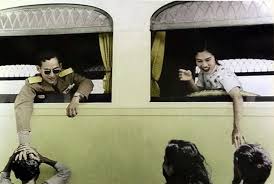
Image result for ในหลวง อย่าทิ้งประชาชนI have no wonder why Thai people love the King so much and I know why I love the King because his majesty is the father of the Thai nation, of us all. The King had left so many things for Thai people especially
His Majesty’s Royal Chitralada Projects and Philosophy of Sufficiency Economy.

As His Majesty said, “development must burst from within.”

I have a lot more to say but if I continued I wouldn't know how to end it. I just realized why some people said that if someone ask  them about the king or why Thai people love their King so much they will ask those people back "How much time do you have to listen?"
_______________________________________ 
Reference
Thai king death: Thousands queue to pay respects at palace. (2016, October 15). BBC News. Retrieved from http://www.bbc.com/news/world-asia-37665762

Saturday, 15 October 2016

Peace Accolades for Putin

What I found in the news
In "Vladimir Putin just Won an International Peace Prize", Bearak first summarized despite what he had done in the past few years, Putin was awarded of Hugo Chavez Price of peace and sovereignty. he also mentioned that Putin also had received Peace award from China.
_______________________________________ 

My response
It kind of surprise me to know that Putin could win a Peace prize. Very well I don't know much about him but he seems to be a good leader. One of my friends really like him. When I ask her why, she said his method is decisive and bring prosperity into Russia. For me Russia is on a good term with China but not with the States which I think that's how it should be.

Last year however there was a conflict breaking out in Syria. This event reminds me of Cold War between US and Russia when they fought each other in foreign territories. So similar is that if it had not been for the scope of conflict that limits in a few countries, this would have been called Cold War II. This CWII also affect many other countries including Germany, France because these countries have to take refugee and bring a complication into their own countries.

Still I just wish that we would not have any war ever again.
_______________________________________ 
Reference
Bearak, M. (2016, October 11). Vladimir Putin just won an international peace prize. The Washington Post. Retrieved from https://www.washingtonpost.com/news/worldviews/wp/2016/10/11/vladimir-putin-just-won-an-international-peace-prize/

Thursday, 13 October 2016

Another step of medical field

What I found in the news
According to the Economist's "How to spot children’s speaking and listening problems early",
Ms. Gong and Dr. Guttag, both computer scientist, teach the machine to diagnose language and speech disorder. They did the experiment with 231 children by recording their speech and let the machine to distinguish the disorder, then compare to the result diagnosed by two speech pathologists, Ms. Hogan and Dr. Green. The accuracy of the machine distinguisher is 72 %. They believe if such system were developed and converted to an application, it would help parents to test their children and receive the warning sign earlier whether something wrong.
_______________________________________ 

My response
I like their idea that they use the machines to help other people. Even though it is not 100 % correct in their algorithm, it can be developed and get better.

I believe computer science, in the future, even at the present, plays the important role in medical field more and more. Many medications and vaccines cannot be invented without computer science.
_______________________________________ 
Reference
How to spot children’s speaking and listening problems early. (2016, October 8th). The Economist. Retrieved from http://www.economist.com/news/science-and-technology/21708217-how-spot-childrens-speaking-and-listening-problems-early-sounds-trouble

Rewriting our stories (Skillful, p.82, Critical thinking 1 & 2)

Source background
On page 82, Rogers and Wilkin ask a couple of questions to practice our critical thinking skills.
_______________________________________ 

Discuss these question in a comment below.
  1. Do you agree that past events and how we view them shape who we become in the future?
    • I think (that) past events shape / don't shape us because …
  1. Why do you think that people focus on positive rather than negative memories?
    • We tend to focus on positive memories because …
Think about the ideas from the two readings "National Hero" and "Mixed Memories".
  1. Why do we rewrite the stories of famous people in history? Is it for the same reasons we rewrite our own life stories?
    • The reasons are / aren't the same because … 
    • It is / isn't the same because ... 
  2. When talking about the past, how can you change how a situation is portrayed? 
    • The main factors are … 
___________
Reference
Rogers, L. & Wilkin, J. (2013). Skillful Reading & Writing, Student's Book 2. London: Macmillan.

Wednesday, 12 October 2016

What is the priority of having children ?


What I found in the news
According to the BBC News article "What should come first, a baby or a flat?


", Nowadays Singapore is facing a problem of an ageing population because of lowing birth rates so their government try to solve the problem by encourage citizens to have their children. One of politician, Ms. Josephine Teo, candidate was asked that if some reasons of not having children especially young Singaporeans was because they had to wait too long to have their own houses and It’s hard to have babies if they still live with their parents. Ms. Teo gave her viewpoint that Accommodation shouldn't be a priority and she also gave some examples of being family and have children process from other countries in otherwise in the formation tell about the price of accommodation in Singapore is very expensive and likely difficult to get their own. After that her suggestions instigated ferocious discuss in online society.
_______________________________________ 

My response

I think this problem is happening in many countries and it will effects to economics but when i was reading this article I thought about one point that she may forgot to think about quality of childern because sometimes accommodation can show that they are affordable.for Thailand I think we are facing with this problem too but in specific class of people , most graduated people have less children because they plan a lot of things and moreover people who have more children likely have  lower income and don't plan to have them and we can see it in the NEWS sometimes. 
_______________________________________ 
Reference
What should come first, a baby or a flat?. (2016 October 12).BBC News. Retrieved from http://www.bbc.com/news/world-asia-37627269