My academic interest is biology. I always wondered how human body works when I was a child. I was always curious why we could do what we do. We are not running on batteries like cars or on electricity like machines but what exactly is the mechanism that make us move the way we do or function the way we do. Then, I studied biology when I entered primary school. I got the general idea on how our body works but still I think it is a miracle that our body can just do things automatically with just a thought in our heads. Do you have this kind of feeling? That you understand things in your head but you still have the feeling that there is a mystery in it that you can't quite understand.
My other academic interest is movie which I am not quite sure if I can call it an academic interest. I love watching TV series and movies, especially American's but I do not only watch them for just entertainment. I always think about the plot and the settings of the movies or series I watch.
Wednesday, 11 June 2014


Te's Academic Interests.
My academic interest when I was a highschooler is everything about science including Physics, Mathematics, alo my major Chemistry but not Biology. The special topic which I was really into it is astronomy. My interest in astronomy is in physical terms for example "what is Big Bang?", or "How do black hole form?" These topics always need some basic knowledge of general physics, so this explain my interest in physics. Because I want to understand it deeply, I always find myself reading a lot of books about physics which lead me to read Einstein work about special relativity. At that time I don't really get it at all but at least I find it is more interesting than biology which I think there are a lot of facts we have to remember and less understanding.
Mathematics is also one of my interest.
Mathematics is also one of my interest.
Earng's Academic Interests
My academic interest when I was in primary school was medicine. I found it very interesting to learn how to use various types of medication and surgeries to cure people's diseases. I also thought that medicine was a very good way to apply scientific method in a daily life basis.
My other academic interest was language. As I was born to a mother who is an English teacher, I always had a pleasure reading English books and conversing with foreigners. When I was in college, I also found that learning other languages is not that hard so I took classes in Spanish and Chinese. I think learning languages is a good way to relax yourself.
Another interest of mine was nature. When I was very small, every time I saw a new kind of animals, I would try to look it up in a books or magazines because I wanted to know more about it.
Karn's Academic Interests
I have a lot of academic interests. Mostly, they are related to environment and nature.
I love animals very much since I was young, so at that time I dreamed to be a veterinarian. When I grow up, my love for animals still exists, but it changes a little. Instead of healing injured animals, now I prefer getting closer to their natural livings in the wild and protecting their species. Therefore, I'd like to study the courses related to wildlife reservation and it will be fantastic if those courses have field trip.
May's Academic Interests
My academic interest is in the field of astronomy. When I was a child I read a lot of astronomy books, and I found that the world outside the earth absolutely interested me. I love watching at the stars at night. I always watch the stars with my brother, and this has been one of my most favorite hobbies until now. I think that the space has so many things left to be discovered.
Apart from the astronomy, I also interested in learning new languages. When I was in high school, I had an opportunity to have Japanese classes. The start of my interest in Japanese is from the thing absolutely unrelated to academic. Guess what? I started my interest in Japanese because I like a group of Japanese idols. However, when I look back, I feel really thankful to them because without them as my inspiration, I will never have a chance to know another language apart from Thai and English.
Apart from the astronomy, I also interested in learning new languages. When I was in high school, I had an opportunity to have Japanese classes. The start of my interest in Japanese is from the thing absolutely unrelated to academic. Guess what? I started my interest in Japanese because I like a group of Japanese idols. However, when I look back, I feel really thankful to them because without them as my inspiration, I will never have a chance to know another language apart from Thai and English.
ICE's Academic Interests
I do love all Physical Sciences. I like the Geography, Geology and Oceanography, of which study about the earth structure. When I was younger as a student in secondary school, I did an easy model in Science class using water and oil put it together in a glass box to demonstrate the El Nino and La nino phenomenon. When I was older a bit, I do love to study the Astronomy and Geology. I love to read the book about the land under our feet and the sky above our head. I can look at the star map and read the name of the star out loud for many times to remember them. When I was a student in Economics, I still do interest in this science. Everytime I went to the bookstore, I read the Oceanography text quickly and looked to the beautiful illustrated of the oceans and its cycle. I used to go to study in Economic Geography
Mook's Academic Interests
Not only Economics but also the cosmic that I am really interested in. It started when I read the story about time and space. I thought it was amazing when time is not necessary to be the same everywhere in the universe. This is quite challenging our perception because it contrasts with our feelings. Then, I want to know more about the reason behind that cause. So, I learned the related theories which made me more surprised, especially the idea that we could go to the future. It sounds like fiction but it can really happen. However, there is no concrete experiment based on that idea since we cannot travel with so high level of speed that could make difference between people who move and the people who stay still.
Jan's Acedemic Interests
My acedemic interests out side the university is about politics. I have been doing research about Thai politics and the conflict we have now comparing to other country's situation and how they can solve their ploblems. The main reasion I'm doing this because I want to know deep down of the problem since we have been finding solution to resolve this conflict for more than 9 years, but the situation is just getting worst. So I think doing research and comparing to other contry would be the better idea to deal with the issue even if it might take longer time but this way would be more sustain to the country.
Besides politics, I'm interested in interantional labour problem that cause many in Thailand such as illegal alien, some of them don't have equal right, some of them don't have basic health care insurance, unfair payment and compensation package from employer, sexual harrasement, or don't even have right to sent their children to school. All these factors are my concern as I will cause problem to this country in the future.
Besides politics, I'm interested in interantional labour problem that cause many in Thailand such as illegal alien, some of them don't have equal right, some of them don't have basic health care insurance, unfair payment and compensation package from employer, sexual harrasement, or don't even have right to sent their children to school. All these factors are my concern as I will cause problem to this country in the future.
Minfa's Academic Interests
Mathematics is my interesting subject. I love mathematics since I was young. Until I studied mathematics in master degree at Chulalongkorn University, I focus on Functional Equation. The Functional Equation is subject in mathematics that is fun and useful. Functional Equation is a subject that solve the functional variables in the equations or system of equations. This subject is very exited and fun since we will find the best method to solve equation. I believe that this subject can apply in Physics or Engineer.
Peter's Academic Interests
My first academic interest came from my interest in growing trees. I grew up on a farm in the country, but it wasn't that the got my interest. I loved TV more than farm work, but one day I watched a gardening show, the sort of thing that my middle-aged aunts might enjoy. The show was about Japanese bonsai, growing trees in miniature. This fascinated me, and I wanted to try it. Living on a farm, in a beautiful rural setting, there was no shortage of trees. For some reason I don't remember, I had always liked fig trees, so I found a small one, potted it, and began my exploration of bonsai. I seen had a small collection of small trees on the supports for one of the water tanks that held the rain water we drank. I spend hours tending them, twisting them into the shapes I wanted with bits of copper wire from my dad's workshop. This interest also led me to start reading about botany, which was the start of my interest in science, although the botanical focus didn't last long.
At the same time, I had discovered my parents' excellent encyclopaedia, which introduced me to other sciences, but also to art, especially the classical art, literature and customs of Western civilization (very little on Asia, except the Ancient Near East). In turn, this prompted me to start looking at more books, and it coincided with starting high school at age 12.
At the same time, I had discovered my parents' excellent encyclopaedia, which introduced me to other sciences, but also to art, especially the classical art, literature and customs of Western civilization (very little on Asia, except the Ancient Near East). In turn, this prompted me to start looking at more books, and it coincided with starting high school at age 12.
Friday, 6 June 2014
AEP Last Day
 |
| All the good times, by Ball, 5 June 2014 |
Hello teacher Peter. You taught us so much this term. Thank you so much for all you have done, for all of us. We wish we could learn from you again.
Best regards,
Everyone
_________
Thursday, 5 June 2014
A further note on knowledge
During your excellent discussion on knowledge on Wednesday morning, in which facts, truth and proof all played important roles, we were left with a definition of knowledge as true belief. If you continued to think about it afterwards, a serious flaw in this definition might have occurred to you.
Since this is a somewhat abstract and challenging issue, an example might help. Consider this example: I have a dream in which I see our class tomorrow. The details are a bit blurry, but I can clearly see that there are twelve students present. I believe my dream, so as I'm walking to room B2 at 9:29 AM tomorrow morning, I have the belief that there are twelve students present. In fact, there are twelve students present, so my belief is true. But do I know that there are twelve students present? No It would seem strange to call this true belief knowledge, because although I do have a true belief, it's true purely by accident, by lucky coincidence.
If you would like a more dramatic example, I can vary dream. In the revised dream, I see the exact amount of money that Petch has with her, 1,287 Baht. Again, I have great faith in my dreams, so I believe that Petch has 1,287 Baht when I walk into the room. In fact, she does have exactly that amount with her. Do we want to say that I know this, that my belief about her currently carried cash is knowledge?
happily, your discussion also helps us here: the importance of reasons, of having the right sort of reasons, also came up in the discussion, and that seems to be the sort of thing we need to also include in a definition of knowledge, which now becomes: knowledge is a true belief that is believed for the right sort of reasons. A shorter way of saying this is that knowledge is justified, true belief.
This is more or less the definition that Plato arrived at around 2,400 years ago (Theaetetus, Meno), and it lasted even longer than Aristotle's well justified belief that the sun circled the Earth, which belief was always false so never knowledge, although it was accepted as knowledge by all educated people in the West for 2,000 years. Plato's suggested definition of knowledge lasted pretty well until 1963, when a few well-crafted examples showed that it had some problems.
However, just as schools continue to teach Newton as a useful way to get a grasp on understanding motion and gravity, so too can you comfortably continue with an understanding of knowledge as justified, true belief.
__________
Wednesday, 4 June 2014
Art as the Mirror of Everyday Life. Quest 2, p. 85 - 87. Term 3, 2014.
These are colour images of the works of art discussed in "Art as the Mirror of Everyday Life" (Hartmann, 2007, pp. 85 - 87)

Hartmann, P. (2007). Quest 2 Reading and Writing (2nd ed.). New York: McGraw-Hill.
 |
| Court Ladies Preparing Newly Woven Silk, by Zhao Ji, China, 12th century |
 |
| Février des Très Riches Heures du Duc de Berry Illumination by the Limbourg Brothers, France, early 15th century. |
 |
| Count of the Cattle, Tomb of Meketre, circa 2000 B.C.E. |

 |
| John Brown Going to His Hanging, by Horace Pippin, 1942. |
__________
Reference
The Sacred Realm of Art. Quest 2, pp. 76 - 82. Term 3, 2014.
These are the images shown or discussed in "The Sacred Realm of Art" (Hartmann, 2007, pp. 76 - 82).
For more information, see "Santa Trinita Maestà" at http://en.wikipedia.org/w/index.php?title=Santa_Trinita_Maest%C3%A0&oldid=485139381
Hartmann, P. (2007). Quest 2 Reading and Writing (2nd. ed.). New York: McGraw-Hill.
 |
| Standing Figure Holding a Baby, Olmec, 800 - 500 B.C.E. |
For more information, see Standing Figure Holding a Baby at http://www.brooklynmuseum.org/opencollection/objects/5073/Standing_Figure_Holding_a__Baby/right_tab/posse/
 |
| Bwa tribal mask and costume. Burkina Faso. |
 |
| Bwa tribal mask. Burkina Faso. |
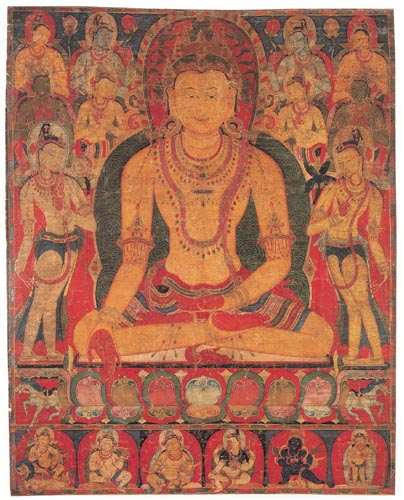 |
| Tathagatas Ratnasambhava, Central Tibet, ca. 1200-1250 |
This is a different version of the work discussed in Quest, which I was unable to find. I think it's similar enough not to matter. I'm not sure that the reference information given in Quest is correct (p. 270). For more information, see Three Tathagatasat http://www.asianart.com/exhibitions/svision/i23.html
 |
| Madonna Enthroned by Cimabue. c. 1285. |
__________
Reference
Looking at art: What's the story? Quest 2, pp. 72 - 75. Term 3, 2014.
These are colour images of the works of art discussed in "Looking at Art: What's the Story" (Hartmann, 2007, pp. 72 - 75). First is the Edomite figure shown on page 72. (There is a slightly fuller version here of this reading, using the same sources.)

 For more information see "Cult" Stand, Statue Anthropomorphic, Painted at http://www.antiquities.org.il/t/Item_en.aspx?pic_id=1&CurrentPageKey=107_1
These are the three pieces of art that Hartmann presents in black and white on pages 74 - 75.
__________
Hartmann, P. (2007). Quest 2 Reading and Writing (2nd. ed.). New York: McGraw-Hill.
 |
| "Cult" Stand, Statue Anthropomorphic, Painted 800 - 600 B.C.E. |


These are the three pieces of art that Hartmann presents in black and white on pages 74 - 75.
 |
| The Art Critic by Norman Rockwell, 1955 |
 |
| Aquila degli Abruzi by Henri Cartier-Bresson, 1952. |
 |
| Street Scene, Haiti, by Laetitia. 20th C. |
__________
Reference
Art: Themes and Purposes. Quest 2, Unit 2, chapter 3. Term 3, 2014
For the rest of the term in Quest, we will be reading about and discussing art.
An obvious first question might be: What is art?
However, Hartmann limits her discussion to a much narrower set of art: the visual arts, starting with the image above on the opening page of chapter 3, and we too can probably ignore the difficult question of what art is, even if we do not limit ourselves here to the traditional visual forms of art that are the subject of chapter 3 of Quest (2007, p. 71 - 104).
Write down your responses to Hartmann's questions on page 73, as below:
Hartmann, P. (2007). Quest 2 Reading and Writing (2nd. ed.). New York: McGraw-Hill.
 |
| Painting Van Gogh by T. F. Chen, 1991 |
However, Hartmann limits her discussion to a much narrower set of art: the visual arts, starting with the image above on the opening page of chapter 3, and we too can probably ignore the difficult question of what art is, even if we do not limit ourselves here to the traditional visual forms of art that are the subject of chapter 3 of Quest (2007, p. 71 - 104).
Write down your responses to Hartmann's questions on page 73, as below:
- Look at the picture. What images do you see in the painting? Are they realistic?
- What do you like or dislike about this painting? Why?
- What is your favourite work of art? Why do you like it? (p. 71) You need not limit yourself to visual art in responding to this question.
__________
Reference
Monday, 2 June 2014
Hundreds of millions heads are better than one
Working as a team can make a difficult task to be an easy one. Human beings are social animals, and they usually live in group; however, some animals live in a group as a social structures in order to survive. Sperm cells are an example of working as a team to reach their goal.

According to Human sperm swim upstream 'in a shoal', sperm cells work together as a team rather than in competition. Swimming as a shoal give boost to sperm to succeeds in fertilizing the egg.
I think that we all have experienced times when we were in team. I am one of people who love working as a group. Working as a group or team always make our task easier. I learn to plan and organize in team. I always meet new people and know each other. Sharing of ideas is important thing of working as a team. When I was in Peter’s class, I always want to work as a group. I usually lack of self-confidence, so I want to make sure that my ideas are wrong or not. We have all heard the phrase “two heads are better than one”, but I need seventeen head when I have to answer Peter’s questions. A team environment can boost the confidence of me and my friends to do our best work.
However, there are disadvantages of working in a team. My teacher say that “too many chefs spoil the soup.” Sometime working as a team may start a conflict; in addition, people become unwilling to open their minds to other ideas. Some of my friends can’t leave their egos and don’t open their mind.
 I was surprised when I read this news, because I always think that sperm have to compete with other sperm. Prof Dunkel said: "It is a commonly held belief that there is competition between sperm cells, with the fittest reaching the egg first. However, scientists found that sperm work as a team. Egg releases resact to attract sperm, then sperm can swim to egg directly. Until yesterday, I think it must be the odd sperm that is stronger and fitter, and swim faster. Now, many scientist test how sperm move in tube and they think sperm will do the same in the fallopian tube. Science always surprise me.
No one can whistle a symphony. It takes a whole orchestra to play it. ~H.E. Luccock
Human sperm swim upstream 'in a shoal'. (2014, May 27). BBC News Health. Retrieved June 1, 2014 from http://www.bbc.com/news/health-27589816
According to Human sperm swim upstream 'in a shoal', sperm cells work together as a team rather than in competition. Swimming as a shoal give boost to sperm to succeeds in fertilizing the egg.
I think that we all have experienced times when we were in team. I am one of people who love working as a group. Working as a group or team always make our task easier. I learn to plan and organize in team. I always meet new people and know each other. Sharing of ideas is important thing of working as a team. When I was in Peter’s class, I always want to work as a group. I usually lack of self-confidence, so I want to make sure that my ideas are wrong or not. We have all heard the phrase “two heads are better than one”, but I need seventeen head when I have to answer Peter’s questions. A team environment can boost the confidence of me and my friends to do our best work.
However, there are disadvantages of working in a team. My teacher say that “too many chefs spoil the soup.” Sometime working as a team may start a conflict; in addition, people become unwilling to open their minds to other ideas. Some of my friends can’t leave their egos and don’t open their mind.
No one can whistle a symphony. It takes a whole orchestra to play it. ~H.E. Luccock
__________
Reference
‘Right to know’ Vs ‘Right to be forgotten’
I saw news regarding Google’s search results. And, it’s high time that I wrote about it. There are some points on the news that our class might like to discuss.
 According to a list of news in the reference section below concerning search results of Google, the EU court sentences Google to start ‘right to be forgotten’ for which some search results of Google might not be shown due to requesting of users who think that outdated search results affect their reputation.
 According to a list of news in the reference section below concerning search results of Google, the EU court sentences Google to start ‘right to be forgotten’ for which some search results of Google might not be shown due to requesting of users who think that outdated search results affect their reputation.
From my point of view, ‘right to be forgotten’ is reasonable for individuals, but forcing Google to removes search results does not seem useful due to the fact that it doesn't solve the problem and might cause a lot of consequences such as degrading of accessing data on the internet, how to identify that users really want to remove links and how to decide that this data is obsolete and should be removed or not.
The goal of the internet is to distribute information among users, so information always should be shared no matter what kind of information it is. I think that it refers to ‘right to know’. As I also mentioned that it doesn't solve the problem, if you want to remove the information, you should directly contact source owner – not Google. Google just provides search result of your keywords. I think it’s non-sense to cope with Google, because you can remove such links, but the source’s still there, so it's merely hard to access. In addition, even though Google agree to do ‘right to be forgotten’, there are still other search engine providers. Do you want to sue every single search engine providers to remove search results?
Last but not least, doing such thing like removing links might violate a concept of the internet in the future. It might also affect free speech on the internet even though users can state some ideas but no one can access, read and continue to share idea. Is it a good thing or not? And, how can we balance ‘right to be forgotten’ and ‘right to know’? Any discussions are welcomed. :)
EU court backs 'right to be forgotten' in Google case form after EU ruling. (2014, May 13). BBC News Europe. Retrieved 1 June, 2014 from http://www.bbc.com/news/world-europe-27388289
Google agrees to forget. (2014, May 30). BBC News Technology. Retrieved 1 June, 2014 from http://www.bbc.com/news/technology-27634746
Google sets up 'right to be forgotten' form after EU ruling. (2014, May 30). BBC News Technology. Retrieved 1 June, 2014 from http://www.bbc.com/news/technology-27631001
Lee, D. (2014, May 13). What is the 'right to be forgotten'? BBC News Technology. Retrieved 1 June, 2014 from http://www.bbc.com/news/technology-27394751
The goal of the internet is to distribute information among users, so information always should be shared no matter what kind of information it is. I think that it refers to ‘right to know’. As I also mentioned that it doesn't solve the problem, if you want to remove the information, you should directly contact source owner – not Google. Google just provides search result of your keywords. I think it’s non-sense to cope with Google, because you can remove such links, but the source’s still there, so it's merely hard to access. In addition, even though Google agree to do ‘right to be forgotten’, there are still other search engine providers. Do you want to sue every single search engine providers to remove search results?
Last but not least, doing such thing like removing links might violate a concept of the internet in the future. It might also affect free speech on the internet even though users can state some ideas but no one can access, read and continue to share idea. Is it a good thing or not? And, how can we balance ‘right to be forgotten’ and ‘right to know’? Any discussions are welcomed. :)
__________
References
Google agrees to forget. (2014, May 30). BBC News Technology. Retrieved 1 June, 2014 from http://www.bbc.com/news/technology-27634746
Google sets up 'right to be forgotten' form after EU ruling. (2014, May 30). BBC News Technology. Retrieved 1 June, 2014 from http://www.bbc.com/news/technology-27631001
Lee, D. (2014, May 13). What is the 'right to be forgotten'? BBC News Technology. Retrieved 1 June, 2014 from http://www.bbc.com/news/technology-27394751
Friday, 30 May 2014
Google’s driverless cars
 Although,
a concept of driverless cars has been known for many decades, it has never been
come true until now.
According to ‘Where Google trains its drivers not to drive’, today Google announced plans to start building its own self-driving cars with a cute smiling look.
I like that Google decided to put a steering wheel and pedals in its cars because of a safety reason. In an emergency, technology may not be able to figure out a right move as good as humans.
Many old movies about future have scenes that cars speak with passenger and automatically drive. For example, in The 6th day, a movie from year 2000 about human clones starring Arnold Schwarzenegger, there are many scenes that show the auto drive car.
There are many supports that technologies in movies and TV series have led to technologies in the real world. Star Trek is an obvious example. In 1960s, mobile phones are used in the Star Trek 30 years before they were well known. In addition, a universal translator and video conference technologies are presented in the series before someone

It is reasonable that when the technologies were presented on screen, a lot of people wanted them to be real and tried to invent them. I believe that in the near future, I will see a computer showing results in the air which can be controlled by touching the unreal screen in the air, as there were in Iron man and Minority report.
What technology do you want it to become a reality?
__________
Reference
Stewart, Jack (2014, May 28). Where Google trains its drivers not to drive. BBC Future. Retrieved May 30, 2014 from http://www.bbc.com/future/story/20140527-inside-googles-robot-car-lab
Let's sleep in the dark.
As we know that women always care about beauty and health. sleeping is one of the beauty choices for girls who have enough free time, But do you know that where you sleep may affect on your shape too.
 According to "Light bedrooms 'link to obesity'", it states that sleeping in the room with light in average level (enough to see across) will cause obesity in women. This research also found that women with obesity are those who sleep in lighter room because sleeping in the light room may interrupt body clock cycle, Anyway, the research needs to be further studied.
I was surprised when I read this news, because I've never thought that the light level in the bedroom will affect our shape, I always sleep in the dark room because I've heard that growth hormones grow in the dark, but I don't have much sleep so it won't grow anyway. So It's very essential for teenagers to sleep earlier to produce growth hormone.
I think that sleeping in the dark room is not enough if I still sleep less like nowadays, I sleep at 1 AM. for everyday because of doing homework and watching movies as usual, I can't sleep early except the day I do exercise. Or else I'm insomnia; sleep late everyday and try hard to sleep. As a teenager I should go to bed earlier like 11 PM. unless I'll be this short forever.
Gallagher J. (2014, May 29). Light bedroom link to 'obesity' . BBC health news. Retrieved May 31,2014 from http://www.bbc.com/news/health-27617615
I was surprised when I read this news, because I've never thought that the light level in the bedroom will affect our shape, I always sleep in the dark room because I've heard that growth hormones grow in the dark, but I don't have much sleep so it won't grow anyway. So It's very essential for teenagers to sleep earlier to produce growth hormone.
I think that sleeping in the dark room is not enough if I still sleep less like nowadays, I sleep at 1 AM. for everyday because of doing homework and watching movies as usual, I can't sleep early except the day I do exercise. Or else I'm insomnia; sleep late everyday and try hard to sleep. As a teenager I should go to bed earlier like 11 PM. unless I'll be this short forever.
__________
Reference
Subscribe to:
Posts (Atom)